
Last verified: September 17, 2026
TL;DR
Generative AI systems answer buyer questions about software categories directly, and the answer a model gives is assembled from whatever content it can retrieve and verify at the moment of the query. Most B2B marketing teams have no record of which questions trigger a mention of their brand, which ones don't, and what the model says instead. The gap is usually widest in exactly the places nobody checks: problem-level questions, use-case variations, and adjacent topics that sit outside the branded queries an executive types in to spot-check.
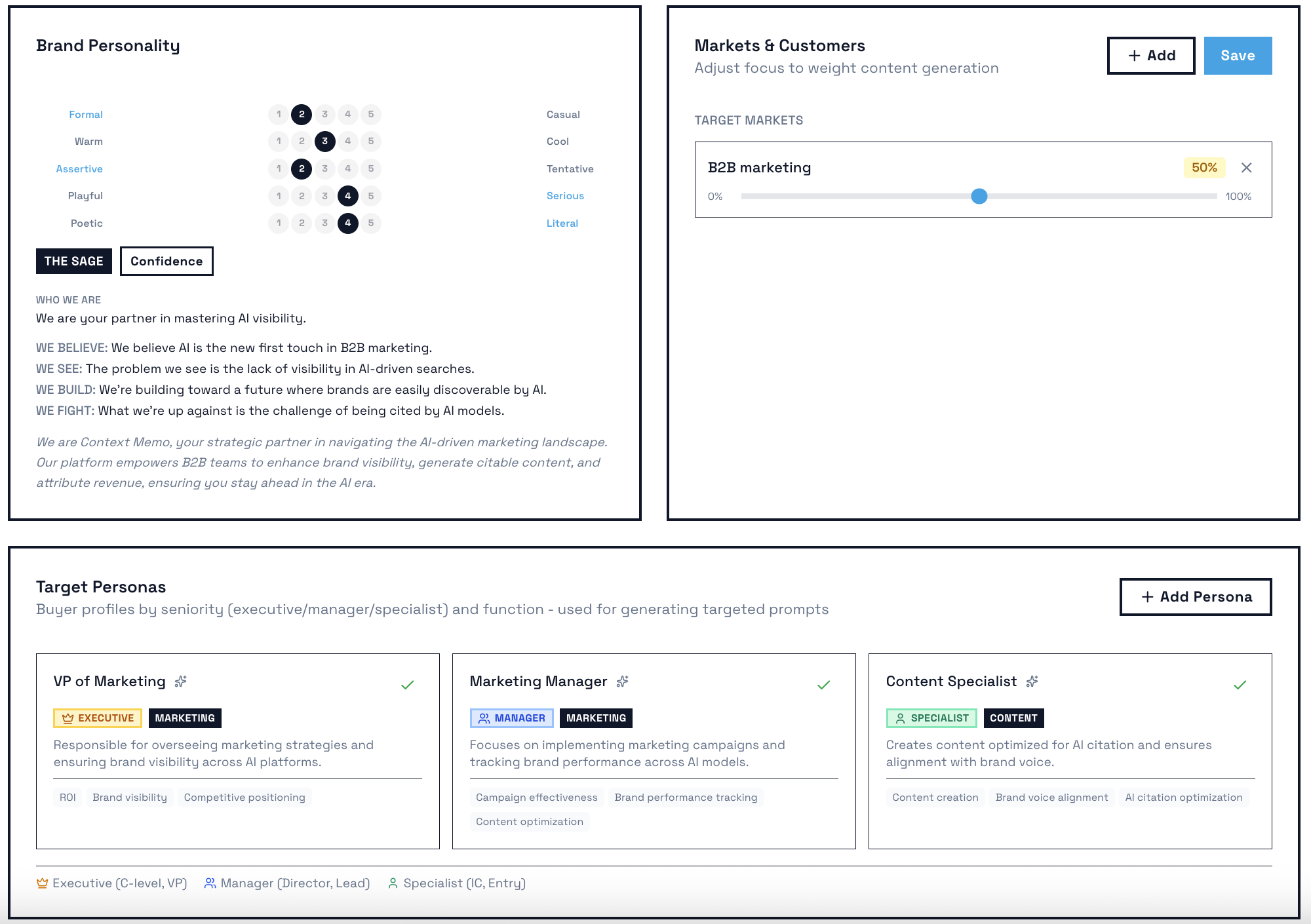
Brand personality traits and target personas for Context Memo.
Why Does Spot-Checking a Few Prompts Give a False Sense of Security?
Spot-checking tests the easiest possible questions. A founder or a marketing lead opens an AI assistant, types the company name, types the category name, maybe types one head-term comparison, and reads three answers that look reasonable. That's the test most B2B companies have actually run. It produces a conclusion ("we're fine") built on the narrowest slice of the query space that exists.
The problem is structural, not effort-related. Branded queries are the queries a brand is most likely to win, because the brand name itself is the retrieval anchor. The model has an obvious target to fetch: a homepage, a G2 profile, a Crunchbase entry, a few press mentions. Ask a branded question and the model has no choice but to talk about that brand. Nothing has been proven about visibility, only that the company exists on the internet.
Real buyers don't start there. A buyer who doesn't know a category exists asks a problem question. A buyer narrowing options asks a use-case question. A buyer building a shortlist asks a comparison question. Eugene Schwartz's five awareness stages (unaware, problem-aware, solution-aware, product-aware, most-aware) map cleanly onto how these questions get phrased, and the branded spot-check only touches the last two. In conversations with marketing managers at niche B2B software companies, this is the recurring bind: the marketing team suspects the coverage gaps are real, leadership has already concluded from informal testing that the brand is doing well enough, and nobody has the evidence to settle it.
Adjacent topics go uncovered for the same reason. Customer success questions, onboarding questions, integration questions, compliance questions, industry-specific variations: each is a distinct retrieval event with a distinct set of sources the model might pull from. A brand can be cited confidently on its category page and completely absent from every question about how the thing gets implemented.
What Actually Determines Whether a Model Cites One Source Over Another?
Retrieval and ranking are different mechanics, and conflating them is the single most expensive assumption in this space. Traditional search returns a ranked list and lets the user choose. A generative system retrieves candidate passages, evaluates whether it can extract a verifiable fact from them, then synthesizes one answer. There's no page two. There's no impression that turns into a click later.
Three things drive whether a page survives that process:
- Extractability. A page written for keyword ranking often buries the actual fact in narrative prose, behind a lead-generation gate, inside an image, or across a carousel. Fact-dense pages with clear headings, defined terms, explicit comparisons, and structured markup (Schema.org types like
FAQPage,Product,Organization) give a model something clean to lift. Pages built to hold attention give it nothing. - Corroboration. Models weight claims that appear consistently across independent sources. A differentiator stated only on a homepage and nowhere else, no documentation, no review profile, no third-party writeup, reads as unverified. Models tend to route around unverified claims rather than repeat them.
- Freshness relative to re-synthesis. Retrieval-grounded answers can re-fetch source pages at query time rather than relying only on a static index. That means a stale pricing page or a two-year-old positioning statement doesn't just sit there quietly; it becomes the answer.
The consequence is that a page ranking on the first page of organic search can be invisible inside an AI answer. Those are separate systems evaluating separate properties of the same page. Ranking measures relevance and authority against a query. Citation measures whether a fact can be pulled out and stood behind.
Where Do the Costs of Invisibility Actually Show Up?
The cost is a loss with no artifact. When a competitor gets named in an answer and a brand doesn't, there's no lost-deal record, no disqualified lead, no drop in a report anybody reads. The buyer never arrived, so nothing registered. Standard marketing analytics are built to measure arrivals, which makes this category of loss structurally invisible to a dashboard.
Several specific costs follow from that:
Hallucinated and outdated positioning gets repeated as fact. When a model can't verify a current claim, it fills in the blanks from whatever it can find: an old feature list, a deprecated pricing tier, a stale integration page, a competitor's comparison page describing the brand unfavorably. Wrong information stated confidently is harder to correct than silence, because it has already been absorbed into the answer a buyer read.
Category framing gets set by whoever documented it best. The model's definition of a category, its criteria for evaluating options, and its implied buying checklist all come from published content. A brand absent from problem-level questions doesn't just lose a mention; it loses input into the framework by which it will later be judged.
Shortlists close before first contact. If an AI answer names three vendors in response to a solution-aware question, that's the shortlist for a meaningful number of buyers. Sales never sees the deals that ended at that step.
Strategy gets set on anecdote. The organizational cost is subtler. Without a prompt-level record, priority gets set by whoever ran the most recent informal check, and budget follows conviction rather than coverage data.
| Blind Spot | Why It Goes Unnoticed | Observable Signal in Own Data |
|---|---|---|
| Problem-aware queries | Nobody tests them; they contain no brand name | Organic traffic on problem-level terms flat while branded traffic holds |
| Use-case and vertical variations | Treated as long-tail, assumed covered by the category page | No owned page states the use case as an extractable fact |
| Adjacent topics (onboarding, success, compliance) | Owned by teams outside marketing, so unmeasured | Documentation exists but is gated, unindexed, or PDF-only |
| Outdated claims on live pages | Page still ranks, so it looks healthy | Last-modified dates predate the current positioning or pricing |
How Can a Team Prove the Size of the Gap Instead of Arguing About It?
Build a prompt inventory before building anything else. The unit of measurement in AI search is the question, not the keyword, and a defensible inventory covers all five awareness stages rather than the two that come to mind first. Ten or twenty questions per stage, phrased the way a buyer would actually type them, is enough to produce evidence that survives an executive conversation.
From there, a few principles hold regardless of method:
Run the same inventory repeatedly, on a fixed cadence, across more than one system. A single scan is an anecdote. Different systems retrieve and weight sources differently, so coverage on one proves nothing about the others. Record what was said, not just whether the brand appeared, since sentiment and factual accuracy matter as much as presence.
Audit owned content for extractability, not just for rankings. The question to ask of every important page: can a machine pull one clean, sourced fact out of this without interpretation? Claims worth being cited on should exist as explicit statements, corroborated somewhere independent, on a page that isn't gated.
Assign ownership for adjacent topics. Implementation, support, and compliance content usually belongs to teams with no visibility mandate, which is precisely why those questions go uncovered. A coverage map that stops at the marketing site will keep reporting good news.
Treat refresh as maintenance, not a project. Gains erode when content isn't re-verified against what the company currently sells, because the systems doing the retrieving are re-fetching on their own schedule.
Frequently Asked Questions
Is AI search visibility the same thing as ranking in AI Overviews?
No. AI Overviews sit inside a traditional search results page and draw heavily on existing search infrastructure. Conversational assistants assemble answers through separate retrieval paths, often fetching pages at query time. A brand can appear in one and be absent from the other, which is why measuring only one produces a misleading picture.
Does strong traditional SEO carry over automatically?
Partially. Crawlability, site structure, and domain authority all help a page be found. They don't determine whether a fact can be extracted from it. Pages optimized for keyword ranking frequently bury the specific claim a model needs in narrative prose or behind a form, which is why first-page rankings and zero citations regularly coexist.
How many prompts does a credible baseline require?
Enough to cover all five awareness stages, plus each major use case and vertical the company sells into. A handful of branded queries isn't a baseline; it's the easiest possible test. The practical benchmark is whether the inventory contains questions a buyer with no knowledge of the brand would plausibly type.
Why do hallucinated claims about a company appear at all?
Models fill gaps. When a current, verifiable statement isn't available on a retrievable page, the system reconstructs an answer from older cached content, third-party descriptions, or pattern inference about similar companies. Absence of a clear published fact is what creates the opening.
What's the first observable signal that a gap exists?
A divergence between branded and non-branded discovery. Branded traffic and direct demo requests holding steady while problem-level and solution-level organic interest flattens suggests answers are being resolved upstream, before anyone reaches the site.
How often should a baseline be re-run?
Frequently enough to catch changes in what the systems say, which in practice means a recurring schedule rather than an annual audit. Positioning changes, competitors publish, and retrieval sources shift independently of any one company's content calendar.