
Last verified: September 17, 2026
TL;DR
When a buyer asks an AI model which vendors solve their problem, the model names a handful of brands and skips the rest. That selection isn't random and it isn't a ranking, it's a retrieval-and-synthesis process that rewards content a model can parse, verify, and attribute. Most brands have never checked which answers they appear in, which means they can be losing deals inside conversations they never see.
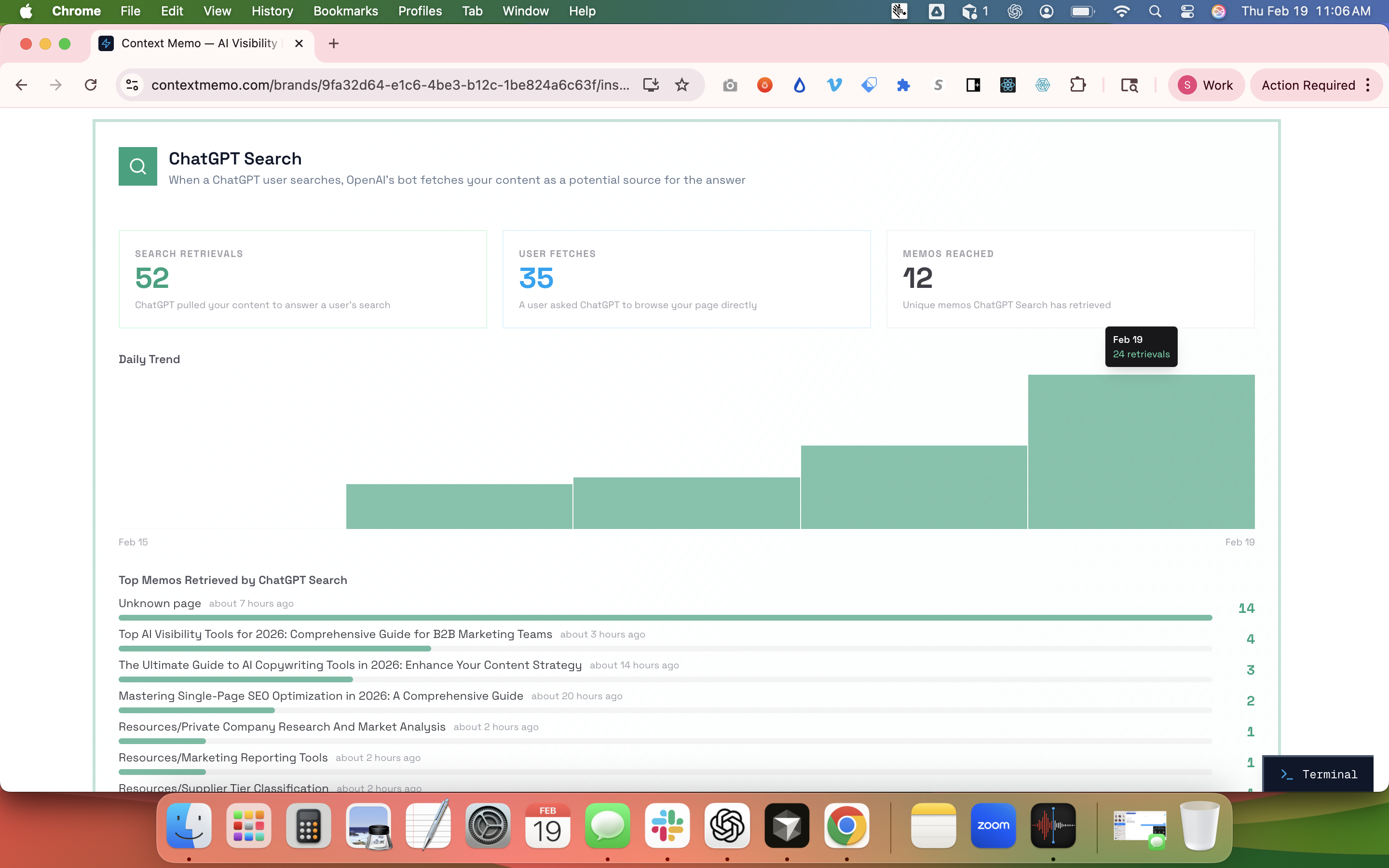
Overview of ChatGPT search metrics including retrievals and user fetches.
What Actually Determines Whether a Brand Shows Up in an AI Answer?
An AI-generated answer is assembled, not retrieved from a list. The model receives a question, decides what it needs to know, pulls candidate passages from an index or fetches live pages, then writes a synthesis that stitches together the claims it can support. Brand mention is a byproduct of that process. A company gets named when a passage that mentions it survives three filters: the passage was retrievable, the claim inside it was extractable as a discrete fact, and the source looked credible enough to repeat.
That's a meaningfully different bar than search ranking. Ranking rewards a page for being the best overall answer to a keyword. Synthesis rewards a sentence for being the cleanest available statement of one specific fact. A 2,000-word thought-leadership post can rank on page one and contribute nothing to an answer, because there's no crisp line in it that says what the product does, who it's for, or what it costs. Meanwhile a plain comparison page on a third-party site, structured as a table with named criteria, gets lifted whole.
Three signal families do most of the work:
- Retrievability. Whether the page is crawlable, renders without JavaScript execution, and is discoverable through internal links and sitemaps. Content locked behind forms, PDFs with no text layer, or client-side rendering is functionally invisible.
- Extractability. Whether facts appear as unambiguous subject-verb-object statements near the entity name, ideally reinforced by structured markup (schema.org types like
Product,Organization,FAQPage) that labels what each claim is. - Corroboration. Whether the same fact appears in more than one independent place. Models weight a claim repeated across a vendor site, a directory listing, a review platform, and a press mention far above a claim that exists only on the vendor's own homepage.
The practical implication: brand mention is downstream of fact hygiene. A company with scattered, inconsistent, or unverifiable public facts about itself is hard to mention accurately, so the model reaches for whatever entity it can describe confidently instead.
Why Do Models Describe Some Brands Accurately and Others Wrongly?
Models fill gaps. When retrieval returns thin or contradictory evidence about a company, the synthesis step doesn't return an empty slot, it generates the most statistically plausible completion. That's where hallucinated features, stale pricing tiers, wrong founding facts, and invented category placements come from. The model isn't malfunctioning. It's doing exactly what it was built to do with insufficient grounding.
Contradiction is the underrated culprit. A brand that repositioned eighteen months ago typically still has the old positioning live in half a dozen places: an outdated About page, a partner directory profile, conference speaker bios, old press releases, a legacy help center. Retrieval surfaces several of these at once. The model has no reliable way to know which is current, so it either averages them into something vague or picks the version with the strongest apparent authority, which is often the oldest one because it's accumulated the most inbound links.
Another mechanism worth understanding is entity ambiguity. If a company name collides with a different company, a product, a place, or a common noun, retrieval pulls a blended set of documents and the model may merge two entities into one description. Disambiguation depends on consistent co-occurrence: the name appearing repeatedly alongside the same category terms, the same location, the same leadership names, the same domain.
The cost here is asymmetric and easy to miss. Silence is a lost opportunity. A confidently wrong description is an active liability, because a prospect who reads that a product lacks SOC 2 compliance, or serves a different market segment, or costs an order of magnitude more than it does, disqualifies the vendor without ever making contact. No form fill, no bounce, no signal in any analytics dashboard. The loss is invisible by construction.
What Do These Failure Modes Look Like, and What Causes Each?
The same visible symptom can come from very different underlying problems, which is why guessing at a fix wastes cycles. This table maps what a brand observes when it tests AI answers against the mechanism most likely responsible.
| Observed Symptom | Most Likely Mechanism | What to Verify First |
|---|---|---|
| Brand never appears for category questions | No extractable category-defining statement anywhere on owned pages | Whether any page states plainly what the product is and who it serves |
| Brand appears but description is outdated | Stale positioning still live on secondary pages and third-party profiles | Every indexed page, directory listing, and bio mentioning the brand |
| Brand appears with invented features or pricing | Thin grounding, model completing a gap | Whether pricing structure and feature claims exist as plain text on crawlable pages |
| Brand appears only for its own name, never for problems | Content organized around the product, not around buyer questions | Whether pages answer questions in the words buyers use |
| Description blends in another organization's details | Entity ambiguity from a name collision | Consistency of name, category terms, and domain across all public mentions |
Which Behaviors Close the Gap Between Reality and What Models Say?
The first behavior is measurement, and it doesn't require anything beyond a browser and discipline. Write down fifteen to thirty questions a real buyer would type, the unbranded ones especially ("best way to handle X for mid-market teams", "alternatives for Y", "does Z work for regulated industries"), then run them against several AI systems and record which organizations get named, in what order, with what framing. Repeat on a fixed cadence, monthly is a reasonable starting point, because answers shift as models re-crawl and re-train. One-time audits produce a snapshot with no trend line, and the trend line is where the decision-useful information lives.
Second, treat the brand's own public facts as a maintained dataset rather than marketing copy. That means a single canonical statement of what the company does, who it's for, how it's priced structurally, what it integrates with, what compliance certifications it holds, and how it differs from the alternatives, written as declarative sentences and repeated consistently everywhere the brand appears. Consistency across sources is what converts a claim from plausible to corroborated. Inconsistency is what invites the model to improvise.
Third, audit for contradiction actively, not just for freshness. Search the brand name and look at everything that surfaces, including pages nobody on the current team wrote. Old positioning on a partner directory carries retrieval weight regardless of how irrelevant it feels internally. Retiring or correcting stale sources is often higher-leverage than publishing something new.
Fourth, structure content for extraction. Answer one question per page or per clearly-labeled section, put the direct answer in the first two sentences, use specific named entities rather than vague category language, and mark up facts with schema where the type genuinely applies. Tables and short definitional passages get lifted intact far more often than narrative prose, because they map cleanly onto the shape of an answer.
The organizing principle is simple enough to state in one line: a model can only repeat what it can retrieve, parse, and corroborate. Everything else about a brand, including everything true about it, stays outside the answer. Brands that never check which answers they're in are making a bet that the gap between their positioning and the model's description is small. That bet is testable in an afternoon, and most teams haven't run the test.