
Last verified: September 17, 2026
TL;DR
When someone asks ChatGPT, Perplexity, or Google's AI Overviews to recommend a product or compare two companies, the AI model answers directly, often without ever sending that person to a company's website. Most businesses have no idea what these systems are saying about them, whether it's accurate, or whether a competitor is getting named instead. That blind spot is starting to cost real deals, because the AI answer is increasingly the only impression a prospect forms before a shortlist gets built.
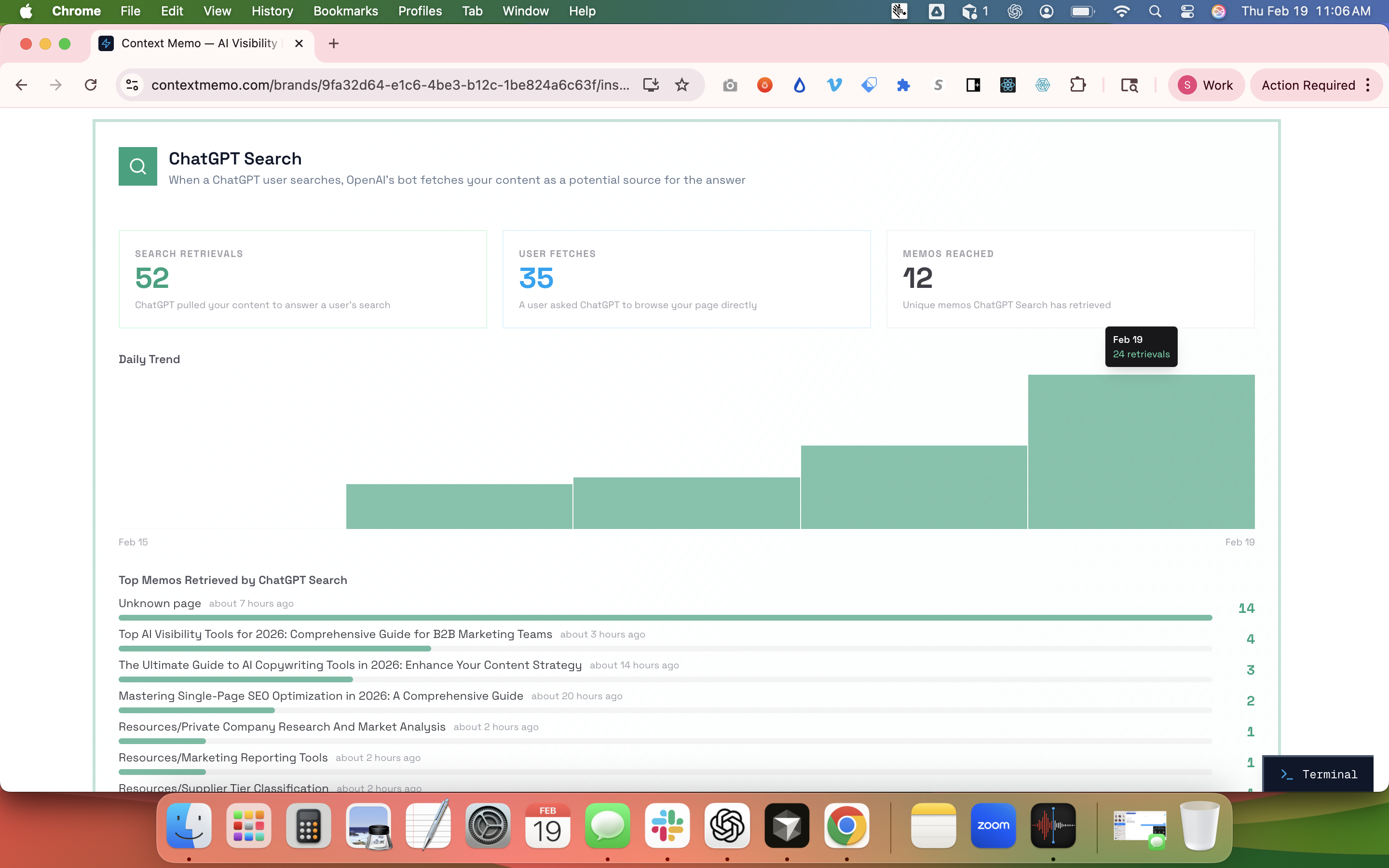
Overview of ChatGPT search metrics including retrievals and user fetches.
What Actually Happens When a Buyer Asks an AI Model Instead of Searching?
The AI model retrieves and assembles an answer from whatever content it can find, parse, and treat as trustworthy, then presents it as a single response with no ranked list underneath. This is a fundamentally different mechanism than a search engine returning ten blue links. There's no scrolling past a bad result to find a better one, and no page two. A business is either part of the synthesized answer or it isn't, and the model makes that call in a fraction of a second based on signals most companies never check.
That single-answer format changes what "visibility" even means. A company can rank first on Google for its own category and still be absent, or misrepresented, when someone asks an AI model the same question in plain language. The two systems are pulling from overlapping content but scoring it against different criteria: keyword relevance and backlinks for search, factual clarity and extractable structure for AI synthesis. A page written to rank can be nearly invisible to a model that's trying to lift a clean fact out of it.
The practical result is that a growing share of early buyer research now happens inside a conversation with a model rather than a browser tab full of tabs. Nobody sees this research happen. There's no referral traffic, no search query report, no bounce rate to inspect. The only way to know what was said is to ask the same questions a buyer would ask, and most companies have never done that.
Why Do AI Models Get Facts About a Company Wrong, or Skip It Entirely?
AI models fill gaps with whatever is available and plausible, and when a company's own site doesn't give them a clean fact to work with, they either guess or default to whoever else showed up in the training and retrieval data. This is the root of the problem, not a bug in any one model. Language models are built to produce a fluent, confident answer regardless of how complete their source material is, so an information gap doesn't produce a hedge. It produces a wrong answer stated with total certainty.
Three conditions make a brand especially vulnerable to this. Pricing, positioning, or feature claims that live only in a PDF, a sales deck, or a gated page are invisible to a model that can't access them, so it has nothing to cite and nothing to correct itself with. Content written for a marketing audience rather than a fact-extraction pass (long narrative sections, vague superlatives, claims without specifics) gives a model little to grab onto. And a company that hasn't published anything comparing itself to alternatives leaves that entire question to be answered by whoever did, usually a competitor or a third-party review site with its own incentives.
None of this is malicious on the model's part. It's a retrieval problem. The model isn't checking a company's records before it answers; it's pattern-matching across whatever text is out there, and text that's outdated, thin, or missing gets treated the same way as text that was never written. A product that shipped a new feature six months ago and never updated its public pages will get described by its old feature set indefinitely, because that's the last version the model ever saw.
What Does It Actually Cost When a Company Is Missing From an AI Answer?
The cost shows up as lost deals a company never knew it was competing for, because the buyer never reached out. A prospect who asks an AI model "what's the best option for X" and gets three names, none of them the company in question, doesn't go looking for a fourth option. That buyer builds a shortlist from the answer they got and moves on. There's no support ticket, no lost-deal note in the CRM, nothing that shows up in a quarterly report labeled "AI visibility." The revenue impact is real and completely undetected by the reporting most sales and marketing teams already run.
There's a second, quieter cost: reputational drift. A model that repeats a stale price point, an outdated feature list, or a comparison that favors a competitor isn't lying on purpose, but the effect on a buyer's perception is the same as if it were. Once a wrong claim gets picked up and repeated across multiple queries, it starts to look like consensus rather than an error, and correcting it takes more than a single updated web page. It takes enough clean, verifiable content that the model has a reason to stop repeating the old version.
The compounding factor is time. Search rankings degrade slowly and predictably; a page that drops from position three to position eight still gets some traffic and gives a team a visible signal to react to. AI citation loss doesn't work that way. A brand can go from being named consistently to being replaced by a competitor across most model responses with no warning and no dashboard flagging the change, because almost nobody is running the same buyer questions against these models on a recurring basis to catch the shift.
Being Findable Is Not the Same as Being Citable
A page can be indexed, ranked, and technically "found" by a crawler while still being useless to a model trying to answer a specific question, and that gap is where most of this problem lives. Search indexing checks whether a page exists and matches a query's keywords. AI citation requires something stricter: the page has to contain a clear, standalone fact that can be lifted out of context and stated as true. A blog post that builds an argument across six paragraphs before stating a number buries that number too deep for extraction. A page that states the number in the first two sentences, with the source and the date attached, gets cited.
A few concrete signals separate content that gets cited from content that gets ignored by these systems:
- Facts stated early and plainly, not built up to through narrative or scene-setting.
- Specific numbers, dates, and named comparisons, since vague claims give a model nothing concrete to quote.
- Structured formatting (headings that match real questions, short paragraphs, tables where the material is genuinely comparative) that lets a model parse the page mechanically rather than infer meaning from prose.
- Content that's current, since a model has no way of knowing a page is stale unless the page itself says so or contradicts something more recent it found elsewhere.
None of these signals require a company to abandon its existing content strategy. They require treating a subset of pages, the ones most likely to answer a buyer's direct question, as reference material first and marketing copy second. Most companies have built years of content optimized for a search engine that ranks pages. Very few have checked whether that same content gives a language model anything it can actually use.