
Last verified: September 17, 2026
TL;DR
B2B marketing teams are measuring a channel that no longer describes where buyers get their answers. Rank positions, click-through rates, and organic session counts all assume a buyer lands on a page and reads it, but a growing share of research now ends inside a generated answer that summarizes a category, names a few vendors, and never sends a click. The gap between what the dashboard reports and what buyers actually see is invisible by design, and it widens quietly until pipeline softens with no obvious cause.
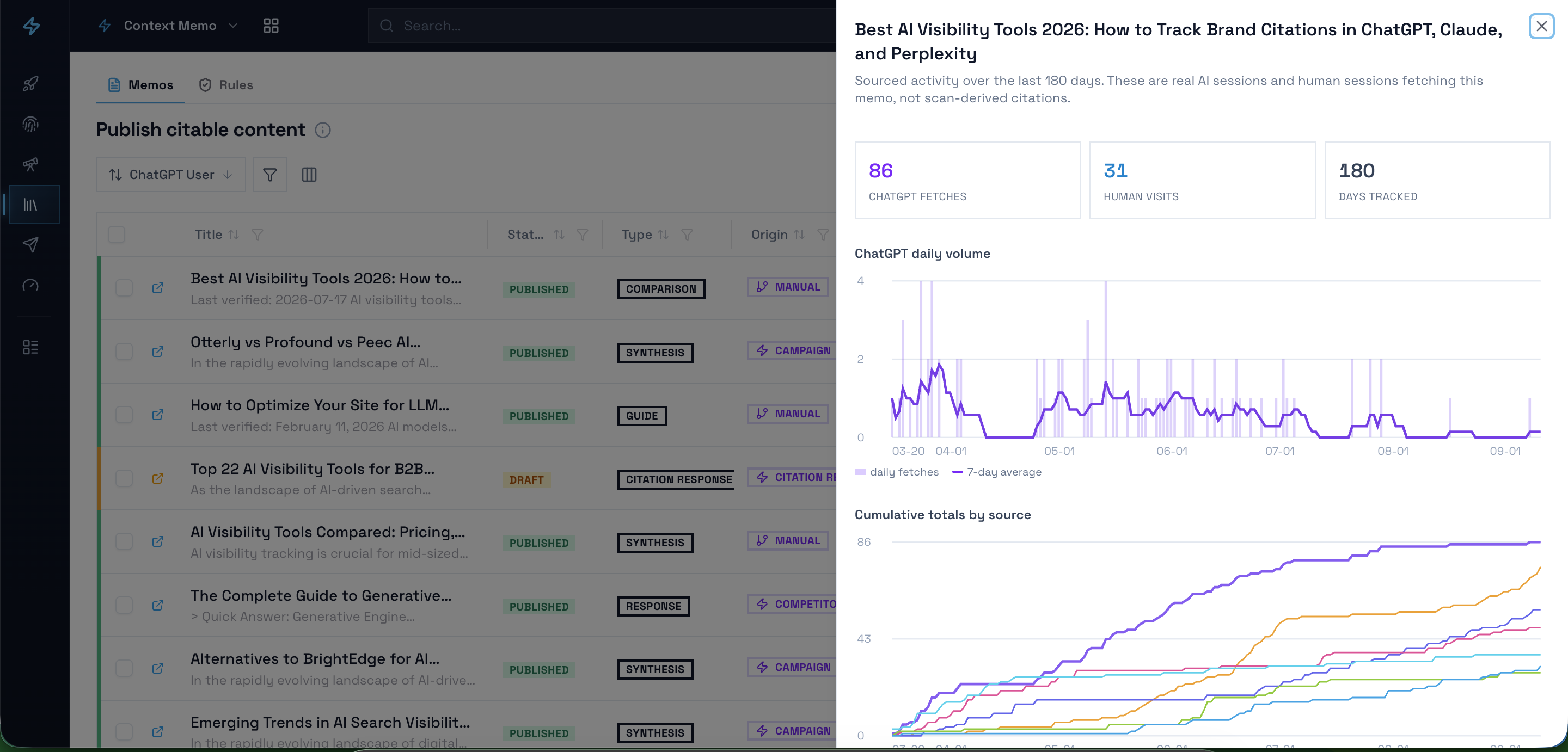
Dashboard showing AI visibility tools metrics and trends.
Why Do Traditional SEO Metrics Stop Describing Buyer Behavior?
Rank tracking measures placement in a list. Generated answers don't produce a list. When a buyer asks a model to compare options in a category, the output is a synthesized paragraph or a short set of named recommendations, assembled at the moment of the query from sources the model can retrieve and parse. There is no position three. There is no page two to recover from. A brand is named in the answer, described accurately in it, or absent from it entirely.
That structural difference breaks the measurement chain in a specific way. Traditional SEO reporting treats impressions as the top of the funnel and clicks as the first evidence of interest. In a generated answer, the impression happens without a click, so the brand can be mentioned dozens of times in buyer research sessions and register zero activity in analytics. The reverse is also true: a page can hold its ranking and its click volume while losing the informational query traffic that used to precede it, because the question that led to that page is now answered before the buyer reaches it.
The practical result is a reporting blind spot that looks like stability. Organic sessions may hold flat while the mix underneath them shifts from research-stage visitors to buyers who already formed an opinion elsewhere. Sales starts hearing objections nobody in marketing has seen written down, and discovery calls begin with a comparison the buyer picked up somewhere unnamed. Teams that only watch aggregate session counts see nothing wrong. Teams that segment by query intent see the research-stage tier erode first.
How Is Content Evaluated Differently by Retrieval Than by Ranking?
Ranking rewards a page. Retrieval rewards a passage. A search engine evaluates the whole document against a query and returns the URL; a retrieval-grounded system pulls the specific chunk of text that answers the question and discards the rest. That single difference explains most of why high-performing SEO content underperforms in generated answers, and it has nothing to do with content quality in the editorial sense.
Content built for ranking tends to front-load context, delay the answer, and distribute a single claim across several paragraphs so the page reads long enough to signal depth. Content that gets retrieved does the opposite: it states the claim in one self-contained sentence, attaches the number or the qualifier to that same sentence, and doesn't require the surrounding paragraphs to make sense. A comparison buried in prose across four screens is one document to a crawler and zero usable passages to a retrieval system. The same comparison in a labeled table with specific column headers is a liftable unit.
Three properties do most of the work, and none of them are keyword-related. First, factual self-containment: a passage that says "pricing follows a per-seat model with an annual commitment" survives extraction, while "as mentioned above, the pricing is structured accordingly" does not. Second, structural legibility: headings phrased as the question a buyer actually asks, tables where the material is genuinely multi-dimensional, and schema markup that labels what an entity is rather than what a page is about. Third, corroboration across sources: a claim that appears only on the brand's own site carries less retrieval weight than one that also appears in third-party coverage, directories, review content, and technical documentation.
The tension for B2B teams is that these properties can conflict with conversion-oriented page design. Landing pages engineered to withhold specifics until a form is filled out give a retrieval system almost nothing to extract. A page can be the best-converting asset in the funnel and simultaneously invisible to the systems buyers now ask first.
| Dimension | Ranking-Oriented Content | Retrieval-Oriented Content |
|---|---|---|
| Unit of evaluation | The full page or document | An individual passage or table row |
| Placement of the claim | Often after context-setting | First sentence, self-contained |
| Specifics (numbers, structures, named entities) | Sometimes withheld to drive form fills | Stated inline, attached to the claim |
| Failure mode | Ranks below the fold | Parses but yields no extractable fact |
What Does an AI Visibility Gap Actually Cost a B2B Pipeline?
The cost shows up as deals that never enter the funnel, which is why it stays undiagnosed. A buyer running category research through a generated answer builds a mental shortlist before any tracked interaction exists. If the brand isn't named at that moment, it isn't excluded by a competitor's better pitch, it's excluded before a pitch is possible. Nothing in CRM records a loss, because nothing was ever an opportunity.
For long-cycle B2B purchases, the exposure is larger than for transactional categories, and the reason is committee dynamics. Enterprise evaluations typically involve several functions, and the people doing early informational research are frequently not the people who will run the formal RFP. A technical lead, a procurement analyst, and a line-of-business owner may each ask a model to explain the category, and each of those sessions can produce a different description of the same brand. Inconsistency compounds: a model that fills a gap with outdated positioning, a deprecated feature, or a mismatched category label plants that version of the story in three separate heads before the vendor is ever contacted.
There's a second cost that rarely gets attributed correctly: sales cycle friction from misinformation the vendor never published. When a generated answer describes a product using information from an old press release, a stale integration list, or a third-party roundup written two years ago, the sales team spends discovery calls correcting the record instead of qualifying. That correction time is measurable, and it's usually logged as "long sales cycle" rather than as a content or visibility problem.
The third cost is strategic drift in the content calendar. Teams that plan content from keyword volume data will keep investing in informational topics whose click value is falling, because volume data reports the query, not the click. Budget continues flowing to assets that get summarized rather than visited, while comparison-stage, proof-dense, entity-rich content that retrieval systems actually pull from stays underfunded. The misallocation is invisible until someone segments content ROI by intent stage.
Which Signals Show a Visibility Gap Has Already Opened?
Several observable signals appear before pipeline effects do, and all of them can be checked in data a B2B team already owns:
- Impressions rising while clicks flatten on informational queries. In search console data, a widening impression-to-click gap concentrated on question-formatted and "what is" queries indicates answers being satisfied before the click.
- Referral traffic from generated-answer sources appearing in analytics. Sessions arriving from AI assistant referrers, even at low volume, confirm buyers are reaching the site through synthesized answers, which means other buyers are reaching the answer and stopping there.
- Discovery calls opening with unattributed comparisons. When prospects cite a competitive framing or a feature limitation that appears nowhere in the brand's own material, an external description is doing the positioning.
- Bot and crawler activity from AI user agents in server logs. Crawl requests from model-operated agents show which pages are being fetched for retrieval, and which are being ignored.
- Branded queries growing faster than non-branded discovery queries. This pattern suggests the brand is being found only by people who already knew the name, meaning category-level discovery has moved elsewhere.
- Inconsistent descriptions across repeated prompts. Asking the same category question several times and receiving different vendor sets, or different descriptions of the same brand, indicates thin or contradictory source material rather than a settled answer.
The diagnostic discipline that matters here is prompt-level baselining: writing down the twenty to forty questions a real buyer would actually type at each stage of the evaluation, running them on a fixed schedule, and logging which brands get named and how each is characterized. Without that baseline, any change in AI-driven visibility is unattributable, because there's no prior state to compare against. With it, the erosion or the gain becomes a tracked number instead of an anecdote.
What Changes in Practice for Teams That Take This Seriously?
The shift is from optimizing for placement to optimizing for extractability and corroboration, and it changes the work more than it changes the budget. Pages get restructured so that every material claim exists as a self-contained sentence with its specifics attached. Comparison and pricing-structure information moves above the form rather than behind it. Entity facts (what the company is, what category it belongs to, who it serves, what it integrates with) get stated consistently across the site, third-party profiles, documentation, and any content the brand can influence, because retrieval weights agreement across sources.
Refresh cadence becomes a governance question rather than an editorial preference. Stale facts on a live page don't sit harmlessly; they get retrieved and repeated with confidence. A page listing a deprecated capability or a former pricing model can actively generate wrong answers for as long as it remains indexable. Teams that treat content as a durable asset with a review date, rather than as a publish-and-move-on deliverable, cut off the most common source of hallucinated brand claims.
Measurement expands to include share of voice inside generated answers alongside rank and traffic. That means tracking mention rate across a fixed prompt set, sentiment and accuracy of the description, which sources the answer cites, and whether the brand appears in comparison-stage prompts as well as category-definition prompts. None of these replace SEO reporting. They sit next to it, because crawlability, site architecture, and page authority still determine whether content is discoverable enough to be retrieved in the first place.
The teams most exposed are the ones with strong traditional SEO performance, because their dashboards look healthy and their instinct is to trust them. Flat sessions and stable rankings can coexist with a complete absence from the answers that now shape the shortlist. The check is cheap: run the buyer's actual questions, read what comes back, and compare it to what the brand believes is true about itself.
Frequently Asked Questions
Does Traditional SEO Still Matter if Buyers Ask AI Models Instead?
Yes, and the mechanism is direct: retrieval systems can only surface content they can crawl, parse, and verify. Site architecture, internal linking, page speed, indexability, and domain authority still govern whether content is available to be retrieved at all. What changes is that ranking position stops being the outcome variable and becomes an input to a different outcome, which is whether a passage gets selected and cited inside a generated answer.
Why Can a Page Rank on the First Page and Still Be Absent From AI Answers?
Because ranking evaluates documents and retrieval evaluates passages. A page can earn its ranking through backlinks, topical breadth, and engagement signals while containing no self-contained sentence that answers the specific question asked. If the key fact is distributed across several paragraphs, dependent on earlier context, or withheld behind a form, there is no clean unit for a retrieval system to lift.
How Should Content ROI Be Measured When Answers Don't Generate Clicks?
By adding mention-rate and citation-rate against a fixed prompt set to the existing traffic and conversion metrics, and by segmenting content performance by intent stage rather than by aggregate sessions. Informational content should be judged partly on whether it gets cited in category-definition answers, and comparison content on whether it gets cited in evaluation-stage answers. Aggregate organic session counts hide the exact substitution that's occurring underneath them.
Which Internal Teams Need to Be Involved Beyond SEO?
Product marketing owns the factual source of truth (positioning, category label, named use cases, proof points, differentiation), and without that, restructured content just re-publishes guesswork in a cleaner format. Marketing operations owns publishing access and analytics segmentation. Sales provides the highest-value input, which is the actual language and objections prospects bring to first calls, since those reveal what external descriptions are already circulating.
Is This a Content Problem or a Technical Problem?
Both, and they fail in different ways. The technical layer determines whether content is fetchable and machine-readable, which covers crawl access for model-operated agents, structured data markup, clean HTML, and server response behavior. The content layer determines whether anything worth extracting exists once it's fetched. Fixing one without the other produces either well-structured pages nobody can reach or reachable pages with no usable facts in them.
How Often Should a Prompt Baseline Be Re-Run?
Frequently enough that changes are attributable to specific publishing decisions, which in practice means a fixed recurring schedule rather than ad hoc checks. Models update their retrieval and re-synthesize on their own timelines, so a single snapshot describes one moment and nothing more. The value comes from the trend line: which prompts moved, which competitors got displaced, and which descriptions of the brand changed after a specific page was rewritten or a stale asset was retired.