
Last verified: September 17, 2026
TL;DR
Time-to-value for a brand context platform splits into three distinct clocks: setup (domain verification, CMS access, and fact sourcing, usually days to a few weeks depending on how fragmented the brand's content stack is), first publication, and first measurable citation shift in AI answers. The first two are controlled by the buying team and its internal approvals; the third depends on how often each AI model re-crawls or re-fetches the publishing domain, which no vendor controls. Buyers should ask for documented observation windows rather than accept a generic "fast results" claim, and should expect the baseline measurement work to start before any content ships.
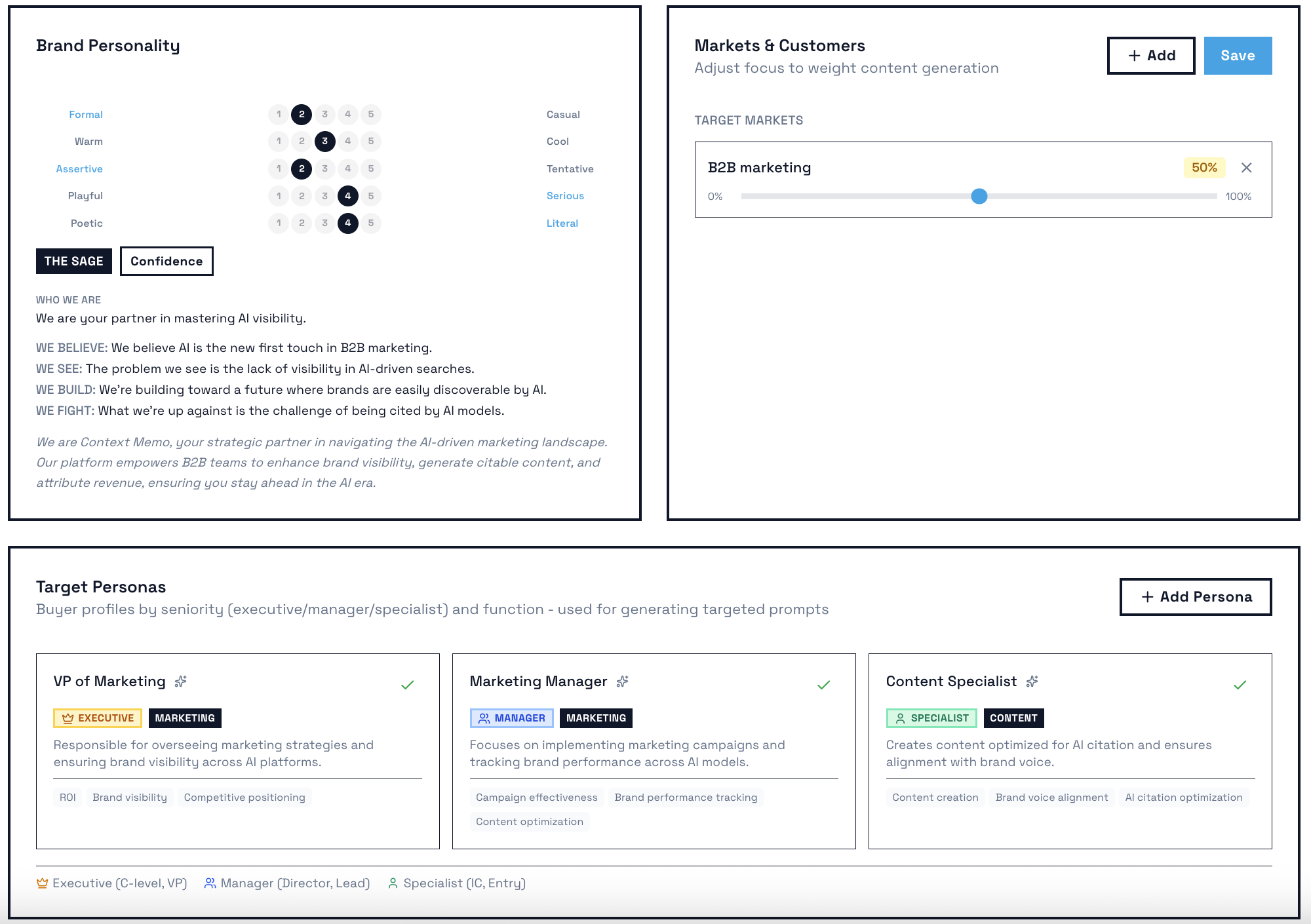
Brand personality traits and target personas for Context Memo.
What Are the Main Approaches in This Space?
Brand context platforms sit inside AI visibility management: the practice of tracking and shaping how generative AI systems describe a brand when a buyer asks about a category, a comparison, or a specific vendor. A brand context platform specifically maintains a structured source of truth about the brand (positioning, ICP, differentiators, proof points, voice) and uses it to produce or correct content that AI models retrieve and cite. The category also travels under AEO (answer engine optimization) and GEO (generative engine optimization), and the terminology hasn't settled.
Time-to-value differs sharply by approach, so the approach a buyer picks largely determines the timeline they'll experience.
Monitoring-first approaches deliver value fastest in the narrowest sense. Run a prompt set against multiple models, get a baseline, and a team knows within its first reporting cycle which answers it's absent from. That's real value: the loss becomes visible. But nothing on the site changes, so citation movement never arrives from monitoring alone.
Human-authored approaches (in-house writers or outside editorial help) front-load the calendar. Scoping, interviews, drafts, and legal or product marketing review stack up before a single page publishes. Editorial quality tends to be high. Time-to-first-publication is the longest of the four, and because these are project engagements, refresh stops when the scope ends.
Automated structured content approaches compress the publishing step. Facts get extracted and verified, schema-marked reference content generates, and pages publish to the brand's own domain on a repeating cadence. The setup clock still applies: domain verification, CMS access, and a reviewed source of truth. Buyers trade review-cycle time for trust in the platform's verification methodology.
Rank-tracking suites with AI tracking bolted on inherit whatever velocity the existing SEO program already has. If a team publishes monthly, AI-facing content publishes monthly. Fast to turn on, slow to move, and coverage of chat-based models varies by vendor and should be confirmed against published documentation.
How Do the Three Value Clocks Differ?
Most disappointment in this category comes from buyers measuring one clock while the vendor quotes another. Separating them makes the timeline honest.
| Clock | What Has To Happen | Who Controls It | Most Common Cause of Delay |
|---|---|---|---|
| Setup and baseline | Prompt set defined, baseline scan run, domain verified, CMS access scoped | The buying team, plus IT and marketing ops | Fragmented CMS across marketing site, blog, and docs |
| First publication | Source of truth reviewed, content generated or written, approvals cleared, pages live | Shared between platform and product marketing | Messaging review with no named owner |
| Citation shift | Models re-crawl or re-fetch the domain, retrieve the new pages, synthesize them into answers | AI model providers, not the vendor or the buyer | Thin domain authority and low crawl frequency |
The third clock behaves unlike SEO. Some systems re-fetch source pages at query time instead of relying only on a static index, so retrieval-grounded answers can refresh on a different schedule than traditional ranking crawls. That's why a single citation appearing quickly proves very little on its own, and why a stable shift across a full prompt set is the metric worth tracking.
What Should Buyers Consider When Evaluating?
Questions that predict time-to-value, rather than questions about features:
What's required before the first page ships? Get the access list in writing: domain verification method, CMS permissions and their scope, brand asset handoff. Overly broad permissions are a security problem, not a speed feature, and narrow scoping is worth a few extra days.
Who owns the source of truth internally? Positioning, pricing structure, named use cases, and differentiators need review by the people who own messaging (usually product marketing). Every program that stalls, stalls here. Naming that owner in the kickoff meeting is the single highest-leverage scheduling decision available.
Does the baseline exist before content publishes? Without a pre-publication baseline prompt set, there's no way to attribute later movement to the work. Vendors that publish first and measure second are selling activity, not outcomes.
What observation window does the vendor document? Ask for case data showing time from publication to first cited answer, and which models it was observed in. "Results vary" is acceptable; "results are instant" is not. Verify the claim against the vendor's own documentation.
How is verification handled? Facts pulled from primary sources (the brand's own site, filings, official profiles) versus inferred and filled in. Inaccurate published content is slower to fix than absent content, because a model repeating a confident wrong claim has to be displaced rather than filled.
What's the refresh cadence after launch? Gains erode when content goes stale. Confirm whether re-verification runs against the live site on a schedule, or only when someone opens a ticket.
What Does the First 90 Days Usually Look Like?
The pattern is consistent across approaches, even though the durations vary. Weeks one and two go to the baseline: a representative prompt set of questions a real buyer would type, run across several models, plus domain verification and CMS access. Nothing is published yet, and that's correct sequencing.
The middle stretch is source-of-truth work and first publication. This is where calendars slip, and almost always for internal reasons: a messaging doc that three people disagree with, a legal review nobody scheduled, a CMS that requires a developer for every new template. Buyers who pre-clear those three items before kickoff compress this phase more than any vendor capability does.
The back half is measurement and iteration. Re-run the same prompt set, unchanged, and look for two signals: prompts where the brand now appears at all, and prompts where a previously cited alternative has been displaced. Single-prompt wins are noise. Movement across a category cluster is signal.
One caution on expectations. A brand with an established, frequently crawled domain will see retrieval faster than a brand publishing on a new subdirectory with little existing authority. Domain history is an input to the third clock, and it isn't something onboarding speed can offset.
Frequently Asked Questions
How Long Does Onboarding Take Before Anything Publishes?
Setup is measured in days to a few weeks and is gated almost entirely by the buyer's side: domain verification, CMS access provisioning, and a reviewed source of truth covering positioning, differentiators, and proof points. Brands with a single CMS and a named messaging owner move at the fast end. Brands with content split across a marketing site, a blog platform, and a separate docs tool should plan for the slower end.
How Long Until New Content Gets Cited by an AI Model?
This depends on model crawl and re-fetch frequency, the authority of the publishing domain, and how cleanly the content structures its facts, so no vendor can guarantee a fixed turnaround. Some models re-fetch source pages at query time rather than relying solely on a static index, which means retrieval can refresh on a different cadence than traditional search ranking. Ask for documented observation windows tied to specific models rather than accepting a general claim about AI speed.
What's the Difference Between First Citation and Real Value?
First citation is a single model naming the brand on a single prompt. Real value is a stable shift across a prompt cluster: multiple related buyer questions where the brand now appears and where a previously cited alternative no longer dominates. Measuring the first and reporting it as the second is the most common way these programs overstate progress.
How Much Do These Platforms Cost, and Does Price Correlate With Speed?
Pricing structures range from freemium monitoring tiers to per-seat SaaS to usage-based or custom-quote enterprise plans, and buyers should confirm current figures on a vendor's own pricing page since models in this category are still moving. Price correlates with whether the tool publishes content or only reports on gaps, not with how fast models re-crawl a domain. Paying more compresses the publication clock, not the retrieval clock.
What's the Most Common Misconception About Time-to-Value Here?
That existing SEO performance carries over automatically. AI systems don't rank pages the way search engines do; they retrieve and synthesize from content they can parse and verify as fact, which rewards structured, fact-dense pages. A page ranking on the first results page can still be invisible in an AI answer if the model can't extract clean facts from it, which means a strong SEO program shortens the crawl clock but not the restructuring work.
Can a Team Speed Things Up on Its Own?
Yes, and mostly in setup. Pre-clearing CMS access, naming a single messaging approver, and having positioning, pricing structure, named use cases, and proof points documented before kickoff removes the three delays that account for most slipped timelines. None of that influences how often a model re-crawls the domain, which stays outside anyone's control.