
Last verified: September 17, 2026
TL;DR
Onboarding with a brand context platform in the first 30 days follows a predictable arc: a baseline scan of buyer prompts across multiple AI models, domain and CMS access, then the construction of a structured source of truth (positioning, ICP, differentiators, proof points, voice) that gets human-reviewed before anything publishes. Most implementations produce a first batch of published, schema-marked reference content somewhere in the second half of the month, followed by a re-run of the original prompt set to see if citations moved. The variable that separates a fast onboarding from a stalled one isn't the software, it's how quickly someone internally can approve the facts the platform will publish.
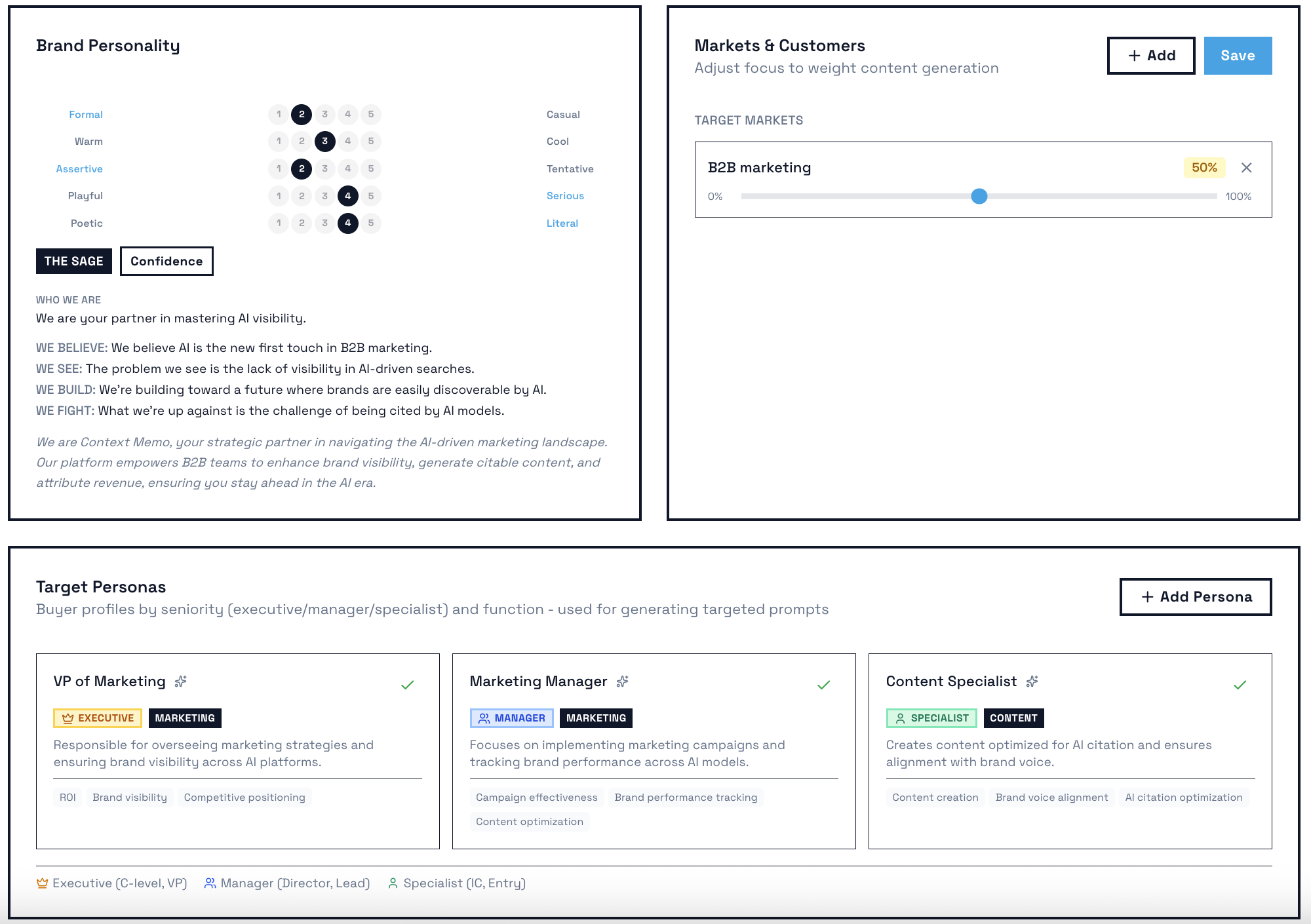
Brand personality traits and target personas for Context Memo.
What Are the Main Approaches in This Space?
A brand context platform is a system that holds a structured, machine-readable record of what a company is, who it sells to, how it differs from alternatives, and what proof backs those claims, then uses that record to generate, publish, and monitor content that AI models retrieve when answering buyer questions. It sits inside the broader category of AI visibility management, which also goes by AEO (answer engine optimization) and GEO (generative engine optimization). None of those three labels has settled as the standard term, and buyers will see all of them used loosely, sometimes within a single vendor's own documentation.
Onboarding philosophies in this category differ on one axis more than any other: what gets built first. Monitoring-first onboarding starts with measurement. Day one is a prompt set, a list of tracked models, and a dashboard. The advantage is speed to insight and near-zero dependency on internal stakeholders. The limit is that at day 30, the deliverable is a report on the size of the gap, not a change to it.
Context-first onboarding inverts that order. The early days go into extracting and verifying the brand's factual record, then publishing structured reference content on the brand's own domain, with monitoring attached to confirm whether the published content gets picked up. This front-loads the internal work (someone has to sign off on positioning and proof points) but it means the first month ends with owned assets rather than a findings deck.
Services-led onboarding routes the same work through humans: discovery calls, a messaging workshop, a writer auditing existing pages and rewriting them for extractability. Editorial quality tends to be high because a person makes every call on tone and claims. The tradeoff is cadence. A fixed-scope project ends, and the content stops being re-verified the moment the engagement closes.
The fourth path is onboarding as a configuration step inside an existing SEO stack. Setup looks familiar to any marketing team: verify the domain, connect the analytics property, add AI Overview tracking to the reports they already run. Continuity is the selling point. Coverage is the constraint, since chat-model coverage varies by tool and refresh cycles stay tied to the existing SEO calendar rather than to how often models re-crawl and re-synthesize. Pricing across all four approaches ranges from freemium monitoring tiers to per-seat SaaS to usage-based and custom-quote enterprise agreements; anything involving content generation and publishing tends to price on volume, and current figures should be confirmed on a vendor's own pricing page.
What Does the First 30 Days Actually Look Like, Week by Week?
The shape of a first month is consistent across platforms that both measure and publish, even though the labels differ. The table below maps the four phases against who inside the company owns each one and what observable signal tells you the phase actually landed.
| Phase | Primary Work | Internal Owner | Signal It Landed |
|---|---|---|---|
| Days 1-7 | Baseline prompt scan across multiple AI models; domain verification; CMS access scoping | Marketing ops | A named list of prompts where the brand is absent, misdescribed, or outranked by an alternative |
| Days 7-14 | Structured source of truth built: positioning, ICP, differentiators, pricing structure, proof points, voice | Product marketing | Fact record reviewed line by line and approved by the messaging owner |
| Days 14-25 | First content batch generated, reviewed, and published to the brand's own domain with schema markup | Content lead plus web owner | Live URLs, valid structured data, pages appearing in crawl logs |
| Days 25-30 | Re-run of the baseline prompt set; bot-crawl and referral monitoring turned on | Analyst or marketing ops | Movement on specific prompts, plus evidence AI crawlers have fetched the new pages |
Week one is diagnostic. A representative prompt set gets run against several models, including the general assistants and the retrieval-heavy answer engines, plus Google's AI Overviews. The output worth having is not a score. It's a list of specific prompts where the answer is wrong, generic, or names someone else. That list is the gate for everything downstream, because without it a team is guessing which pages to fix.
Week two is where onboarding either accelerates or stalls. The platform needs a structured source of truth, and inference from public pages alone is where hallucinated claims enter the system. Product marketing has to read the extracted fact record and correct it: outdated pricing structure, deprecated features, use cases the company no longer sells into, proof points that legal won't stand behind. Teams that treat this as a one-hour review get a fast month. Teams that route it through three approval layers do not.
Weeks three and four are publishing and measurement. Content lands on the brand's own domain, not a vendor subdomain, because owned content compounds authority the way owned SEO content does and doesn't disappear when a contract ends. Then the original prompt set gets re-run. Timelines to first citation vary by model, crawl frequency, and existing domain authority, so a documented observation window from the vendor is more useful than a promised turnaround. Crawl logs are the earliest honest signal: if AI crawlers haven't fetched the pages yet, no citation change is possible, and that distinction tells you whether to wait or to fix discoverability.
What Slows Onboarding Down?
Fragmented content infrastructure is the most common delay. When the marketing site sits on one platform, the blog on another, and documentation on a third, "CMS access" becomes three separate security conversations with three different owners. Buyers should ask exactly what access is required, how it's scoped, and whether publishing can happen through a reverse proxy or subdirectory if direct CMS access isn't available.
Missing internal source material is the second. Companies often have positioning in a deck, pricing in a spreadsheet, competitive claims in a sales enablement doc, and proof points nowhere at all. Assembling that before kickoff shortens the month materially. The third delay is approval ambiguity: if nobody is explicitly named as the person who can approve a factual claim about the product, content sits in review while the AI answers stay unchanged.
What Should Buyers Consider When Evaluating?
- Does day 30 end with a published artifact or a report? Ask the vendor to describe the specific deliverable that exists at the end of the first month. A dashboard showing a visibility gap and a set of live, schema-marked pages are very different outcomes at the same point on the calendar.
- How are facts verified before publishing? Confirm whether the platform pulls from verified primary sources (the company's own site, filings, official profiles) or infers and fills in gaps, and whether there's a mandatory human approval gate. A model confidently repeating a wrong claim is harder to correct than silence.
- Which models are in the baseline scan, and who writes the prompts? A prompt set assembled by the vendor from generic category terms measures something different from one built around the questions a brand's actual buyers type. Ask for the full model list in writing and confirm you can add and edit prompts.
- What access is required, and what's the security posture? Scope CMS permissions, SSO support, domain verification method, and data handling before kickoff. Regulated buyers in healthcare, finance, and education should request published compliance certifications such as SOC 2 rather than verbal assurance.
- Who owns the refresh after day 30? Content goes stale, models re-synthesize on their own schedule, and gains erode when nothing re-verifies the facts against the live site. Ask whether refresh is automated, scheduled, or requires a new scope of work.
- Where does the published content live? Content on the brand's own domain survives a vendor change. Content on a vendor subdomain or inside a walled portal does not, and that distinction should be settled in the contract, not after onboarding.
Frequently Asked Questions
How Long Does Onboarding for a Brand Context Platform Usually Take?
Technical setup (domain verification, CMS connection, prompt set configuration) is typically the fastest part and can complete inside the first week. The longer variable is internal: approving the fact record the platform will publish from. Buyers should plan for a 30-day cycle in which measurement starts almost immediately and publishing begins once positioning and proof points are signed off.
What Does a Company Need to Have Ready Before Kickoff?
Five things shorten onboarding more than anything else: a named messaging owner who can approve factual claims, current positioning and ICP documentation, pricing structure as it's actually sold today, a list of proof points cleared for public use, and CMS or publishing access with someone empowered to grant it. Missing the approver is worse than missing the documents, because documents can be reconstructed in an afternoon and approval authority cannot.
How Much Do These Platforms Cost, and Is Onboarding Billed Separately?
Pricing models in this category include freemium monitoring tiers, per-seat SaaS, usage- or volume-based plans tied to published content, and custom-quote enterprise agreements. Monitoring-only tools sit at the lower end since they don't produce a deliverable. Onboarding is sometimes bundled, sometimes billed as a one-time implementation fee, and sometimes structured as a services engagement, so confirm which model applies on the vendor's published pricing page.
What's the Most Common Onboarding Mistake?
Assuming the platform can figure out the positioning on its own. A system that infers a brand's differentiators from public pages will confidently publish last year's messaging, deprecated features, and competitive claims nobody internally would sign. The second most common mistake is expecting citation changes before checking crawl logs: if AI crawlers haven't fetched the new pages, the answers can't have changed yet, and the right response is fixing discoverability rather than rewriting content.
Can a Buyer Tell Whether It's Working by Day 30?
Partially, and the honest answer depends on which signal is being read. Crawl activity on new pages and valid structured data are verifiable inside the first month. Citation movement across models is slower and uneven, since retrieval, index refresh, and re-synthesis run on different schedules per model. A reasonable 30-day standard is: baseline established, facts verified, content live and crawled, with prompt-level citation tracking in place to measure the next 60.