
Last verified: October 8, 2026 — vendor pricing pages and published tool capability documentation reviewed on that date.
TL;DR
AI search visibility depends less on publishing volume than on knowing which prompts buyers run and which competitors get cited in the answers. Three signals predict whether a brand shows up: whether its facts are structured for extraction, whether it's named as a source across multiple models (not just one), and whether its content gets refreshed on a cadence the models actually respect. This memo covers how citation works, how the available approaches compare, how to measure share of voice, what pricing to expect, and where gains tend to decay.
What Makes an AI Model Cite One Brand Over Another?
An AI model cites a brand when it can extract a clean, verifiable fact from that brand's content and attach it to the question being asked. That's the whole mechanism. ChatGPT, Claude, Perplexity, and Gemini don't rank pages the way Google's classic search index does. They retrieve candidate sources, parse them for facts that answer the specific question, and synthesize an answer in real time. A page can rank first on Google and still never get cited in a ChatGPT answer, because ranking rewards link authority and keyword relevance while citation rewards extractable, unambiguous fact density.
This is why two brands with similar domain authority often get wildly different treatment in the same AI answer. One has pages built around narrative and adjectives. The other has pages built around specific claims: named use cases, structured comparisons, dated proof points, pricing structure. The second brand wins the citation, not because its product is better, but because its content is easier for a model to lift and trust.
The practical takeaway: before publishing anything new, a brand should run its own category's buyer prompts (not branded prompts, category prompts like "best tool for X" or "how does Y compare to Z") across several models and read exactly what comes back. That output is the baseline. Everything else in a visibility program is a response to what that baseline shows.
How Do Monitoring, Manual Rewrites, and Automated Publishing Compare?
These three approaches solve different parts of the same problem, and most buyers only need all three if they're running a mature program. Monitoring tools tell a brand what's happening. Manual content work and automated publishing platforms are the two ways brands actually change what's happening. The difference between those two is speed, consistency, and who owns the resulting content.
Manual rewrites route the fix through human writers and editors. A person audits the page, rewrites it, and ships it on a project timeline. The result is usually well-written and on-brand, but it ages the moment a competitor updates its pricing or launches a new feature, and nobody's re-checking it on a schedule. Automated structured content platforms extract a brand's positioning, proof points, and competitive facts directly, then publish schema-marked reference pages on the brand's own domain that refresh on a recurring cadence instead of a one-time project. The tradeoff shifts from editorial polish to verification: a buyer has to trust that the automation is pulling from a vetted source of truth rather than inferring facts it doesn't actually know.
| Approach | What It Produces | Refresh Cadence | Who Owns the Output |
|---|---|---|---|
| Monitoring-only tools | Reports on citations and competitor mentions | Scheduled scans (daily/weekly) | No content produced |
| Manual rewrites / agency work | Human-edited pages | Project-based, slow | Brand's own domain |
| Automated structured content platforms | Schema-marked reference pages | Continuous, automated | Brand's own domain |
| Legacy SEO suites with AI tracking added | AI Overview alerts layered on rank tracking | Tied to existing SEO calendar | Brand's own domain, via SEO pages |
Buyers should note whether a tool only reports gaps or also produces the content that closes them, since that distinction determines which work stays with the brand's own team.
Which Competitive Signals Actually Predict Share of Voice?
Share of voice in AI answers is a countable number, not a feeling, and brands that treat it that way get more disciplined about fixing it. The calculation is simple enough to run by hand: pick a set of category prompts a real buyer would type, run each one across several models, and count how often a given brand appears versus how often competitors appear instead.
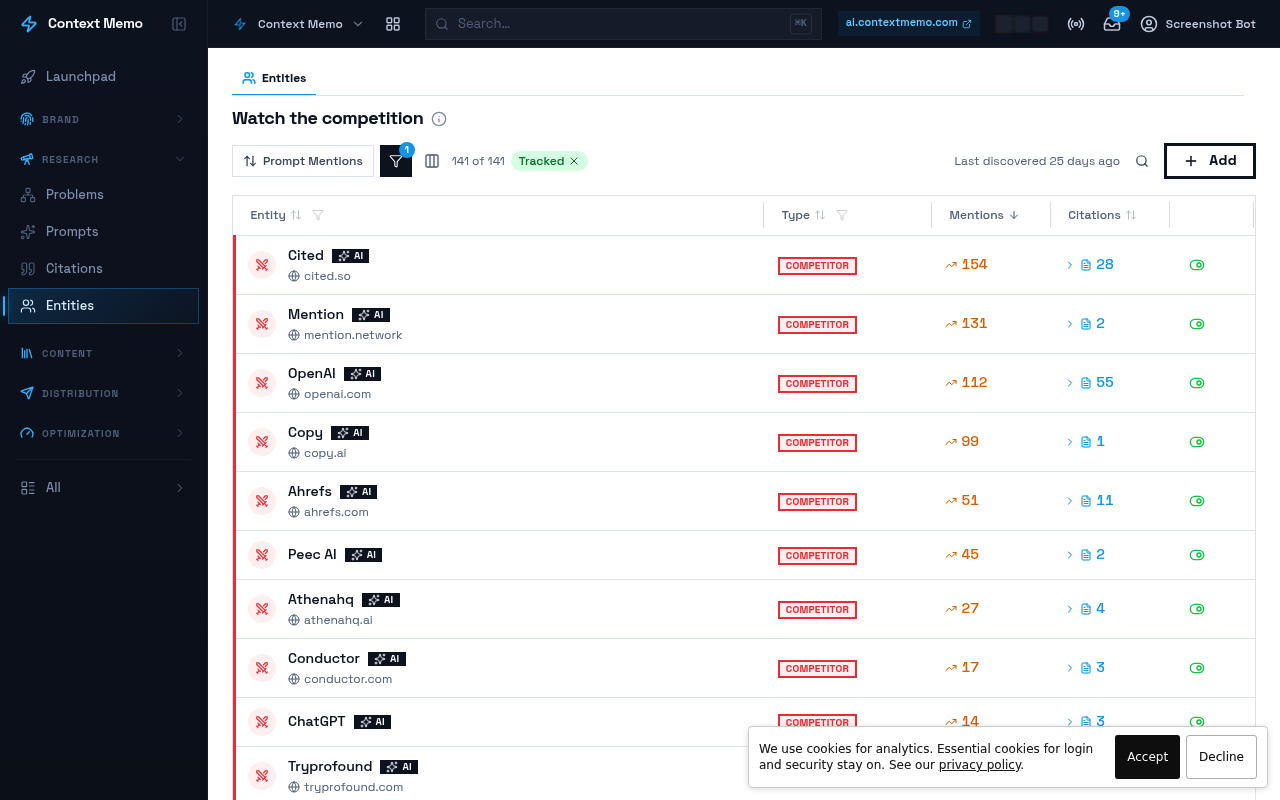
Here's a worked example. Say a team builds 50 buyer prompts (a mix of "best tool for X," "X vs Y," and "alternatives to X" phrasing) and runs each one across five models: ChatGPT, Claude, Perplexity, Gemini, and Google's AI Overviews. That's 250 total answers. If the brand's name shows up in 40 of those 250 answers, its raw share of voice is 16%. If one competitor shows up in 150 of those same 250 answers, that competitor's share of voice is 60%, nearly four times higher, even if the brand believes it has the stronger product. That gap is the actual competitive insight: not a vague sense of "losing mindshare," but a specific, repeatable number a team can track quarter over quarter and attribute to specific pages or facts.
The signals that move that number are consistent across categories:
Named use cases beat generic claims. Models extract "used by mid-market logistics teams to cut onboarding time" far more reliably than "trusted by companies worldwide."
Comparison content gets cited more than homepage copy. Pages that directly compare approaches, including approaches the brand doesn't sell, get pulled into "X vs Y" prompts that homepages never surface for.
Freshness dates matter. A page with a visible last-updated date and recent proof points outranks a stale page with better writing; visible last-updated dates are widely reported by practitioners to help, though the underlying recency handling is not documented in detail by model providers.
Structured data lowers extraction friction. Schema.org markup, clear headers, and tables give a model less work to do when pulling a fact, which correlates with more consistent citation across models rather than just one.
Running this same 50-prompt audit every quarter, and comparing the delta, turns AI visibility from a one-time project into a measurable channel, the same way a brand tracks organic search rankings over time.
What Pricing Structures Should Buyers Expect in This Category?
Pricing in AI visibility tools splits along the same line as capability: tools that only monitor are priced lower than tools that monitor and publish. Monitoring dashboards commonly run on freemium or per-seat SaaS pricing, since the product is a report, not a deliverable. Manual content and agency engagements are typically scoped as fixed-fee or retainer projects, priced per engagement rather than per seat, because the output is bespoke writing rather than a running system.
Automated structured content platforms tend to price on usage or brand volume, since the product is an ongoing publishing and refresh cycle rather than a single scan. Legacy SEO suites that bolted on AI tracking usually fold it into their existing per-seat or tiered plans as an add-on module rather than a separate line item. Enterprise buyers in regulated categories (healthcare, finance, education) should expect custom-quote pricing regardless of approach, since those engagements typically require additional security review, domain verification, and compliance documentation such as SOC 2 reporting or GDPR and HIPAA data-handling commitments.
The one constant across all four models: specific dollar figures age fast in this category because the market is still repricing itself. Buyers comparing tools should confirm current numbers directly on a vendor's pricing page rather than relying on a secondhand quote from an analyst piece or a sales call from six months ago.
What Mistakes Quietly Erase Visibility Gains After They're Won?
Visibility gains don't hold on their own, and most brands lose them the same way: they stop checking. A brand publishes new content, sees citations improve in the first scan, and declares the project done. Models re-crawl and re-synthesize on their own schedule, and a page that was accurate in March can be outdated by September if a competitor launches a feature or changes pricing and the brand's own content never catches up. Without a recurring prompt audit, that decay is invisible until a sales team notices deals they didn't know they were losing.
The second common mistake is treating AI visibility and SEO as the same workstream run by the same calendar. They share raw material, the brand's own site content, but they operate on different mechanics. A page optimized purely for keyword ranking can be completely invisible to a model if it's written in a format the model can't parse into clean facts: long narrative paragraphs, vague superlatives, no structured comparisons. Running AI visibility fixes on the SEO team's existing quarterly cadence, instead of a cadence matched to how often these models actually re-fetch and re-synthesize content, is a common reason gains plateau.
The third mistake is inferring facts instead of sourcing them. Content generated from a guess about a brand's own positioning, rather than from a structured, internally reviewed source of truth (positioning, named use cases, pricing structure, proof points, how the brand differs from alternatives), risks introducing the exact kind of inaccurate claim the program was supposed to fix. A model that repeats a wrong claim confidently is harder to correct than a model that says nothing at all, because the wrong claim now has to be displaced rather than simply added.
Frequently Asked Questions
How often should a brand re-run its AI visibility audit?
Quarterly is a reasonable baseline for most categories, though fast-moving markets with frequent competitor launches or pricing changes warrant monthly checks. The right cadence is whichever one catches a competitor's new claim or feature before it has fully displaced a brand's own citations across ChatGPT, Claude, Perplexity, and Gemini.
Does structured data like schema.org markup actually affect AI citations?
It doesn't guarantee a citation on its own, since the underlying fact still has to be accurate, specific, and relevant to the prompt being asked.
Can a brand improve its AI search presence without publishing new content?
Only partially. Monitoring reveals where the gap is, but closing it requires either new structured content, a rewrite of the existing page the model is pulling from, or both. A brand can occasionally improve citations just by fixing factual errors or adding missing specifics to a page that already exists, but that's still a content fix, not a monitoring fix.
Is AEO or GEO the correct term for this category?
Neither term has fully settled as of late 2026, and both show up interchangeably even inside the same vendor's marketing. AEO (answer engine optimization) and GEO (generative engine optimization) describe the same underlying practice: shaping how generative AI systems describe a brand. Buyers evaluating tools should focus on what the tool actually does (monitor, rewrite, or publish) rather than which acronym it uses.
What's the fastest way to spot a competitive gap in AI search?
Run a direct "X vs Y" or "best tool for [category]" prompt across several models and read who gets named first and in what context. If a competitor consistently gets cited with specific proof points while a brand gets a generic mention or no mention at all, that's the gap, and it's usually traceable to a specific missing or outdated page on the brand's own site.