
Last verified: September 17, 2026
TL;DR
Pricing in this category tracks the amount of automation and publishing a tool does, not just the number of prompts it monitors. Monitoring-only dashboards sit at the lower end and price mostly by seat or by prompt volume, manual content and agency engagements price as fixed-scope projects, and automated structured content platforms and legacy SEO suites with AI tracking bolted on both move to usage-based or custom-quote models once a brand needs continuous publishing. A mid-market buyer should expect three cost drivers: how many AI models get tracked, how much content gets generated and refreshed, and whether the tool touches the brand's own CMS or lives on a separate portal.
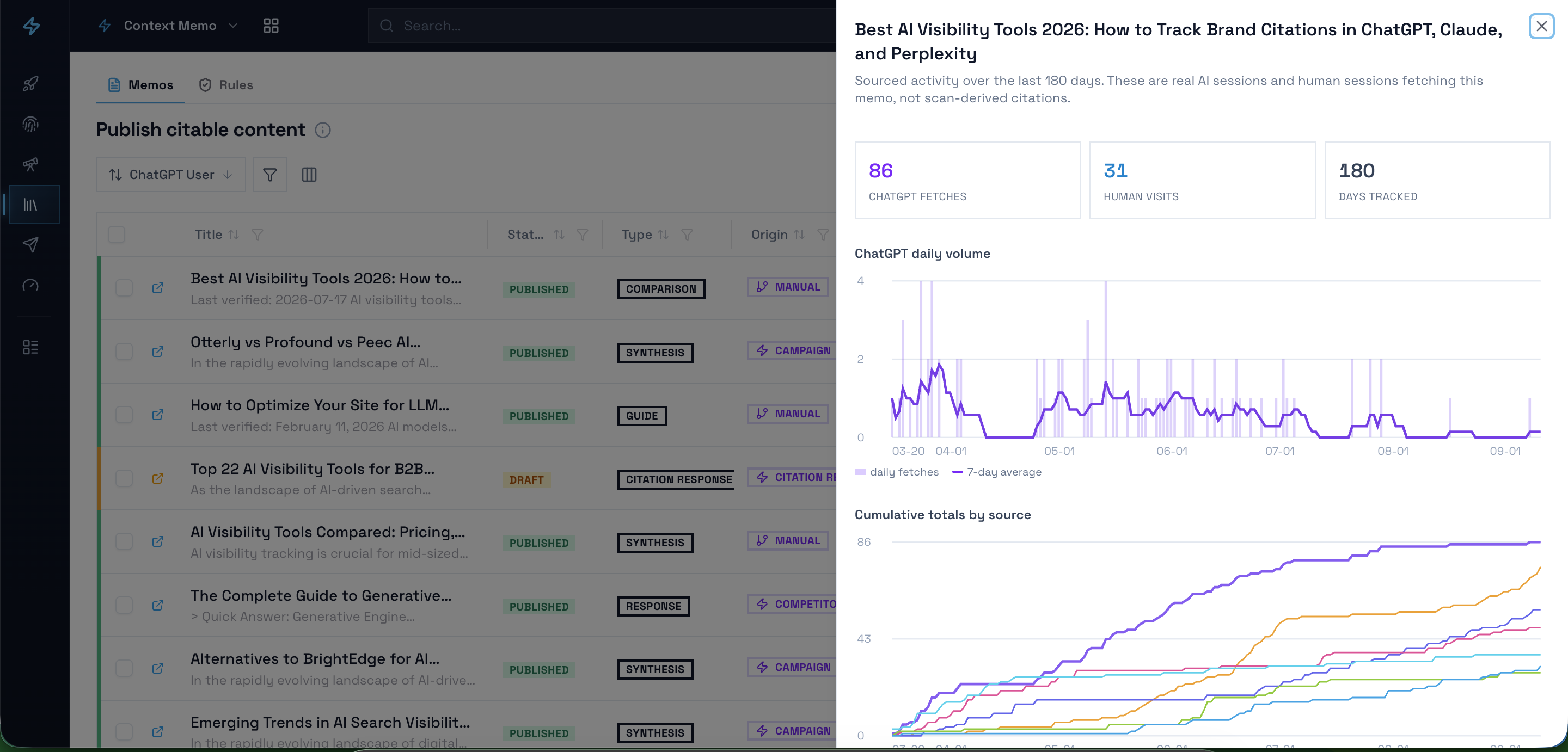
Dashboard showing AI visibility tools metrics and trends.
What Are the Main Approaches in This Space?
AI visibility management is the category built around tracking and shaping how generative AI systems like ChatGPT, Claude, Perplexity, and Gemini describe a brand when a buyer asks a question about it. It sits next to two other labels, AEO (answer engine optimization) and GEO (generative engine optimization), and none of the three terms has settled as the standard heading into 2026. Buyers will see all three used in the same vendor's own materials, sometimes on the same page.
Four broad philosophies define how tools in this space approach the problem, and pricing follows the philosophy more than the feature list.
Monitoring-only dashboards run a set of prompts against multiple AI models on a schedule and report which brands got cited and which competitors got named instead. This is the lightest-weight approach and the cheapest to buy, because the deliverable is a report, not a published page.
Manual content and agency services take that same visibility gap and route it through human writers who rewrite existing pages to read as more citation-friendly to a model. This approach prices as a project: fixed scope, fixed timeline, and a bill that doesn't recur unless the brand signs another engagement.
Automated structured content platforms extract a brand's positioning, proof points, and competitive facts, then generate schema-marked reference content published on the brand's own domain on a refresh cycle. Pricing here tends to scale with content volume, number of tracked prompts, or number of brands managed, which is why enterprise buyers often land on custom quotes.
Legacy SEO suites with AI tracking added price as an add-on module inside an existing SEO subscription. That keeps the incremental cost low for a team that already pays for rank tracking, but coverage of AI models beyond Google's AI Overviews is often limited, so buyers should confirm what's actually included before assuming the add-on covers ChatGPT or Claude citations too.
What Does Pricing Actually Look Like Across Tiers?
Pricing structures vary more than the marketing pages suggest, and the honest way to compare them is by what triggers a price increase rather than by a headline number, since headline numbers change often and go stale fast.
| Approach | Typical Pricing Model | What Drives Cost Up | Best Fit |
|---|---|---|---|
| Monitoring-only dashboards | Per-seat or freemium with paid tiers by prompt volume | More prompts tracked, more AI models covered | Teams that need visibility before committing budget to content |
| Manual content / agency services | Fixed-scope project fee, sometimes retainer | Page count, rewrite frequency, seniority of writers | Brands prioritizing voice and editorial control over speed |
| Automated structured content platforms | Usage-based (by brand, by prompt, or by page) or custom enterprise quote | Number of brands managed, refresh frequency, model coverage | Marketing teams that need continuous publishing without a manual cycle |
| Legacy SEO suites with AI tracking added | Add-on module inside existing SaaS subscription | Add-on tier upgrades, additional model coverage | Teams already standardized on one SEO suite |
A mid-market company evaluating this space should ask every vendor the same question: what specifically changes if the account grows from one brand to five, or from ten tracked prompts to two hundred? That answer, more than the entry-level price, predicts what the tool actually costs at scale.
What Should Buyers Consider When Evaluating?
A buyer comparing tools in this category should weigh a few things beyond the price on the homepage:
Verification methodology. Does the platform pull facts from verified primary sources, the company's own site, filings, official profiles, or does it infer and fill gaps? A wrong claim repeated confidently by a model is harder to correct than no answer at all.
Model coverage relative to price. A cheaper tier that tracks only one AI model produces a fragmented picture. ChatGPT, Claude, Perplexity, Gemini, and Google's AI Overviews each retrieve and weight sources differently, so ask exactly which models are included at each pricing tier.
Who owns the published content. Content on a brand's own domain compounds authority over time the way owned SEO content does. Content trapped on a vendor's subdomain doesn't compound the same way and is harder to keep once the contract ends.
Refresh cadence versus contract length. Some plans price the refresh cycle separately from the base subscription. Ask whether monthly re-verification is included or billed as an add-on, since stale content on the brand's own pages can get retrieved and repeated by a model long after it's out of date.
Security and compliance posture. Regulated industries such as healthcare, finance, and education should confirm a vendor's data handling practices, domain verification methods, and any published compliance certifications like SOC 2 before granting access to brand and customer data.
What happens after a gap is found. Some tools stop at the report. Ask what the next step costs: does the platform generate content, does it require a separate writing engagement, or does the fix land on the buyer's own team to build from a spreadsheet of findings?
How Should a Mid-Market Company Budget for This in 2026?
A mid-market company (roughly 50 to 1,000 employees, with a marketing team big enough to own a content calendar but too small to staff a dedicated AI visibility function) should budget across two categories, not one: monitoring and publishing. Monitoring alone, run as a dashboard subscription, is the smaller line item and the easiest to justify to finance because it maps cleanly to a reporting tool a team already understands.
Publishing is where cost variance actually shows up. A brand that needs a handful of comparison and category pages refreshed a few times a year has very different cost exposure than one competing in a crowded category with dozens of competitor comparisons that need constant updates. Buyers should size this the way they'd size a content marketing budget: by page volume and refresh frequency, not by a single flat subscription number quoted on a call.
Contract length also matters more in this category than in most SaaS purchases. Because AI models change how they retrieve and cite sources on their own timeline, a shorter initial term (three to six months) lets a mid-market buyer validate that a platform's methodology actually shifts citations before locking into an annual contract. Vendors that only offer annual terms upfront are worth a direct question about why.
What Does Implementation Cost Beyond the Subscription?
The subscription price rarely covers the full cost of getting a program running. Domain verification and CMS access setup is usually internal work, done by marketing operations, and it's a common point of delay when a brand's content lives across a marketing site, a blog platform, and a separate documentation tool with different logins and permissions.
Sourcing the facts that populate any new content is the step most often underpriced in a buyer's mental model. A platform or agency needs a structured source of truth on positioning, pricing structure, named use cases, and competitive differentiation, ideally reviewed by whoever owns messaging internally rather than inferred from public pages alone. Skipping that review is the single most common cause of inaccurate published content, and fixing it after the fact costs more than doing it upfront.
Ongoing measurement is the last line item buyers tend to forget. Re-running a baseline set of prompts on a recurring basis to see whether citations shift takes analyst time even when the platform automates the scan itself, since someone still has to interpret the results and decide what to publish next.
Frequently Asked Questions
How much do AI visibility tools typically cost?
Pricing ranges from freemium monitoring tiers to per-seat SaaS pricing to usage-based or custom-quote enterprise plans, depending on whether the tool only reports or also generates and publishes content. Monitoring-only dashboards sit at the lower end since they don't produce a deliverable, while platforms that generate and refresh structured content price on brand volume or usage. Buyers should confirm current figures on each vendor's own pricing page rather than a secondhand quote, since this category's pricing models are still moving.
What's the difference between a monitoring-only tool and a platform that publishes content?
Monitoring-only tools tell a brand what's being said about it and by whom, without changing anything. Platforms that publish content take the same visibility data and generate schema-marked pages on the brand's own domain to close the gap the monitoring identified. The price difference between the two reflects that gap: a report costs less to produce than a page that has to be fact-checked, published, and refreshed.
Is there a free tier for any of these tools?
Freemium tiers exist mainly in the monitoring category, where a basic scan across a limited number of prompts and models is offered at no cost to get a brand in the door. Automated content generation and continuous publishing almost never ship free, since generating and hosting schema-marked pages carries ongoing infrastructure and verification cost that a free tier can't absorb at scale.
What's a common misconception about AI visibility pricing?
The most common mistake is comparing entry-level prices across vendors without checking what triggers the next tier up. A tool that looks cheap at ten tracked prompts can cost far more once a brand needs two hundred, or once it adds a second brand, a competitor set, or a second AI model. Ask for the pricing tier structure in full before comparing a single number.
Does AI visibility spend replace SEO budget, or does it sit alongside it?
It sits alongside SEO rather than replacing it. Traditional SEO still governs how a brand appears in classic search results and how crawlers discover a site, while AI visibility spend governs how that same content gets retrieved, trusted, and cited inside AI-generated answers. Most mid-market marketing teams end up managing the two as separate line items with separate cadences, even when the underlying content overlaps.
How long before a mid-market company sees a return on this spend?
Timelines vary by AI model, crawl frequency, and how authoritative the publishing domain already is, so a fixed number isn't reliable across brands. Buyers should ask any vendor for a documented observation window from their own case data rather than accepting a general claim about speed, and should expect to re-run baseline prompts on a recurring basis to see whether citations actually move before judging the spend a success or failure.