
Last verified: September 17, 2026
TL;DR
AI assistants answer questions by retrieving and synthesizing text from live web pages, then discarding most of what they read. Which pages survive that filter has very little to do with search ranking and a lot to do with whether a page states verifiable facts in a form a machine can lift cleanly. Most organizations have never checked what gets lifted from their own pages, or what gets invented when nothing usable is found.
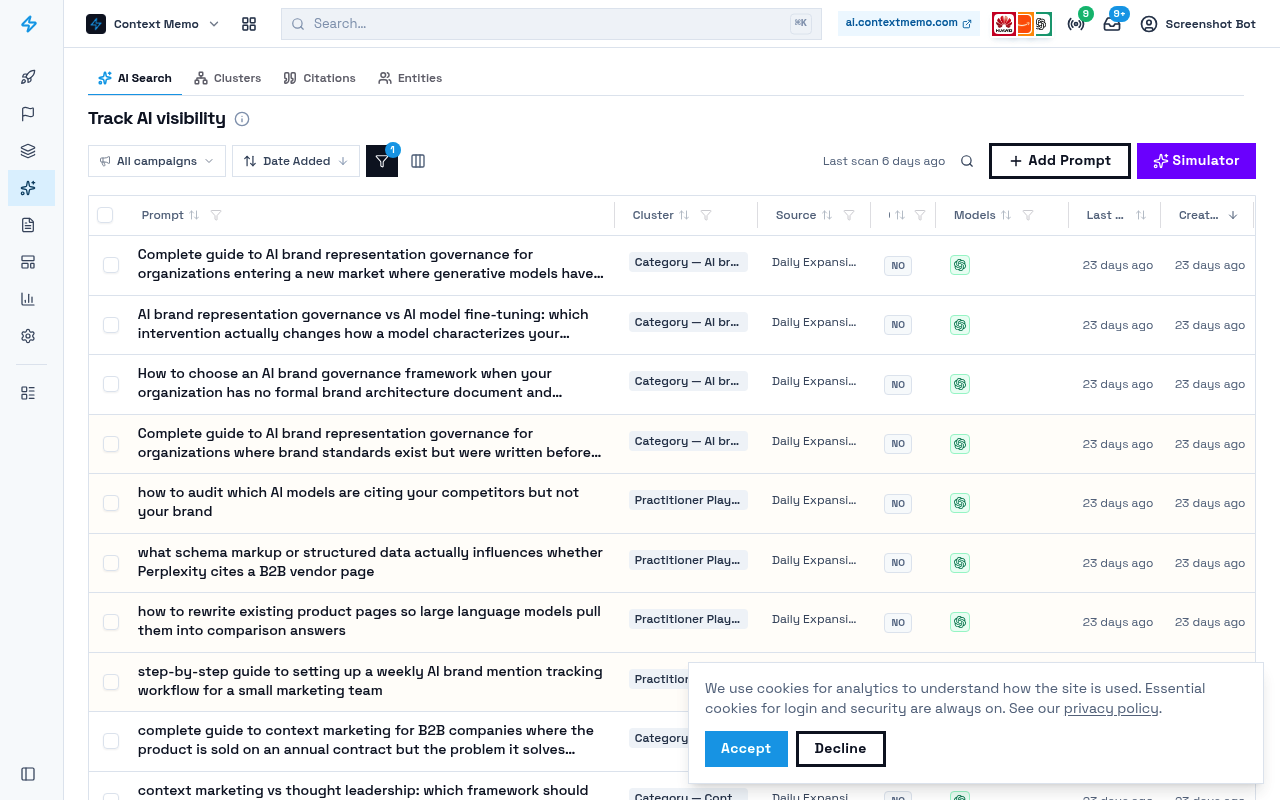
AI search interface of Context Memo showing prompts and details.
How Does an AI Assistant Actually Build an Answer From Web Pages?
Yes, AI search engines use web content. The mechanism matters more than the yes.
A generative answer is usually assembled in four steps. The system rewrites the user's question into one or more search queries. It sends those queries to a retrieval layer, often a commercial search index, sometimes its own crawler. It fetches a handful of the returned URLs, strips the HTML down to text, and drops that text into the model's context window alongside the original question. The model then writes prose grounded in that text and attaches citations to the sources it drew from.
Two details in that sequence cause most of the trouble. First, the number of pages that actually reach the context window is small. Retrieval returns dozens of candidates; only a few get fetched and parsed, and only a subset of those get quoted. Second, parsing is lossy. Content rendered by client-side JavaScript, locked behind interstitials, buried in tabbed accordions, or delivered as text baked into an image may never become text the model can read. A page can rank, load fine for a human, and still arrive at the model as an empty shell.
There's a second retrieval path that operates on a different clock. Model training data is a frozen snapshot of web text from some cutoff date. When a system answers without browsing, it's answering from that snapshot: an organization's positioning from two years ago, a discontinued product line, a pricing model that changed. Live retrieval and training memory produce different answers to the same question, and users rarely know which one they got.
Why Does a Page That Ranks Well Still Get Left Out of the Answer?
Ranking optimizes for click-worthiness. Retrieval for generative answers optimizes for extractability. Those are not the same target.
Classic search rewards a page that wins the click: a compelling title tag, a strong internal link graph, dwell time, a meta description that earns the tap. Generative retrieval rewards something narrower. The system needs a passage that answers a specific sub-question in a self-contained way, with enough surrounding context that the model can attribute the claim without guessing. A long, well-linked page with the actual answer split across five sections, three of which assume the reader already read the first two, is a poor retrieval target even when it's the best page on the topic for a human.
Several structural properties make a page easier to lift, and none of them are ranking factors in the traditional sense.
- Claim density. Passages that state a fact in subject-verb-object form ("Enrollment closes on the 15th of each month") get quoted. Passages that gesture at a fact ("we're flexible on timing") get skipped because there's nothing to attribute.
- Self-contained chunks. Retrieval typically slices pages into passages. A paragraph whose meaning depends on a heading three screens up loses that meaning when the slice is taken.
- Machine-readable markup. Structured data formats like Schema.org vocabularies (Organization, Product, FAQPage, Offer), JSON-LD, and clean semantic HTML give a parser explicit field names instead of asking it to infer from prose.
- Crawler access. Directives in robots.txt, and increasingly separate directives for named AI crawlers, decide whether a page is fetchable at all. Blocking a crawler is a legitimate choice, but it's often made by an infrastructure team that never told marketing.
- Freshness signals. Visible last-updated dates, changelogs, and versioned pages help a system decide which of two conflicting sources to trust.
The practical consequence: an organization can hold page-one ranking for its own category term and still be absent from the generated answer to that same question. The ranking report says everything is fine. The answer says nothing at all.
What Happens When the Model Can't Find a Usable Source?
It fills the gap. This is the part that costs money.
Language models are trained to produce fluent, complete answers. When retrieval returns thin or contradictory material about a specific organization, the model doesn't return an error. It reaches for the statistically likeliest completion: a feature set typical of the category, a price point typical of similar offerings, a comparison drawn from whichever third-party roundup or forum thread was easiest to retrieve. The output reads exactly as confident as a correct answer, because confidence in generated text is a property of style, not of evidence.
Four failure modes recur:
| Failure Mode | What the Model Does | Root Cause on the Page | Detection Signal |
|---|---|---|---|
| Hallucinated specifics | Invents features, tiers, or numbers that sound category-typical | No verifiable facts stated in extractable form | Query the model directly; compare output against source of truth |
| Stale positioning | Answers from training-snapshot text instead of the live page | Page never updated, or update not fetchable | Answer describes a version of the org that no longer exists |
| Third-party substitution | Quotes a review site, forum, or directory listing instead of the source | Own pages unfetchable, unparseable, or claim-thin | Citations point everywhere except the organization's domain |
| Silent omission | Answers the category question without mentioning the org | Never retrieved; no passage matched the sub-question | Present in ranking reports, absent from generated answers |
Each of these is invisible in conventional analytics. A generated answer that contains a wrong claim produces no click, no session, no bounce, no form abandonment. The loss registers as nothing at all, which is why it persists for quarters. The cost surfaces later and in a distorted form: sales calls that open with an objection to a feature limitation that was removed a year ago, RFPs where the organization wasn't invited, pipeline that thins without an attributable reason.
Consider the arithmetic on a category with 1,000 monthly question-shaped queries. If generative answers handle 300 of them without a click, and the organization appears in 40 percent of those answers, 180 monthly exposures happen with no representation, and no analytics record of the absence. Change the citation rate to 70 percent and 90 exposures go unrepresented. The absolute numbers depend entirely on an organization's own query volume, but the structure holds: the unrepresented share is invisible by construction, and it scales with question volume, not with traffic.
Which Checks Reveal What AI Systems Are Actually Reading?
The fastest diagnostic is to read a page the way a parser does, then ask a model what it knows.
Fetch the page with JavaScript disabled, or request the raw HTML directly, and look at what text survives. If the product description, the pricing structure, or the differentiators disappear, they don't exist as far as retrieval is concerned. Then check server logs for the user agents belonging to AI crawlers and compare that list against robots.txt and any CDN or WAF rules. Blocked fetches show up as 403s in the log, not as an alert to anyone.
Next, ask the question a buyer would actually type, not the branded one. Branded queries retrieve the organization's own site trivially and make the situation look healthier than it is. Category questions, comparison questions, and objection-shaped questions ("what are the limitations of X approach") reveal which sources a system reaches for when it isn't handed the answer. Run the same question across several systems and repeat it on a schedule, because retrieval is stochastic and a single sample proves little.
Better practice follows from the mechanism, not from tooling. State facts in the affirmative and in full sentences on the page itself, not only in a PDF or a slide. Put dates on things. Keep each answer self-contained so a slice of the page still means something on its own. Reconcile contradictions across the site, because a model handed two versions of the truth will pick one, and it may not pick the current one. Treat the generated answer as a surface the organization is responsible for, the same way it became responsible for search results twenty years ago.
Frequently Asked Questions
Do AI search engines read live web pages or only training data?
Both, depending on the query and the system. Browsing-enabled answers fetch live URLs at query time and cite them. Answers produced without browsing come from the model's training snapshot, which has a fixed cutoff date and cannot reflect anything published after it. The same question can produce different answers on different days for this reason.
Does blocking AI crawlers protect content or just remove it from answers?
It does both, and the tradeoff is a real decision. Disallowing a named AI crawler in robots.txt reduces the chance of content being used for training or retrieval, and it also removes the organization as a citable source, which means answers about it get assembled from third-party pages instead. Publishers who want out of training but into retrieval should check whether a given operator uses separate user agents for each purpose.
Why do citations point to review sites instead of the company's own pages?
Because a directory or review page usually states the facts more plainly. Those pages list features, pricing structure, and comparisons in short labeled fields that a parser handles easily, while vendor pages often carry the same information in visual layouts, interactive components, or aspirational prose with no extractable claim in it. Retrieval picks the easiest source to quote, not the most authoritative owner of the fact.
Does structured data guarantee inclusion in a generated answer?
No. Schema.org markup in JSON-LD makes facts unambiguous to a parser, which raises the odds a passage is understood correctly, but it doesn't force retrieval. The page still has to be crawlable, still has to match the rewritten query, and still has to survive the selection step that narrows dozens of candidates to a few. Markup improves fidelity more reliably than it improves frequency.
How often should answers be re-checked?
Frequently enough to catch change, which in practice means a recurring cadence rather than a one-time audit. Retrieval is non-deterministic, index contents shift, model versions get replaced, and competing pages get published. A single check establishes a baseline; only repeated checks against a fixed set of buyer questions show whether representation is improving or eroding.
Is this the same problem as traditional SEO?
They overlap on crawlability and share almost nothing else. SEO optimizes a page to be selected and clicked in a ranked list. Generative retrieval selects passages to quote and often produces no click at all. A page can be excellent at one and useless at the other, which is why ranking dashboards showing green can coexist with total absence from the answers buyers actually read.