Last verified: November 7, 2026
TL;DR
AI visibility platform pricing in 2026 falls into four recognizable structures: freemium or low-cost monitoring tiers, per-seat SaaS subscriptions, usage-based pricing tied to tracked prompts or published content volume, and custom-quote enterprise agreements. The structure matters more than the sticker price, because a monitoring dashboard and a platform that publishes and refreshes content are not the same purchase and shouldn't be budgeted as if they were. A pilot budget should be scoped around three variables the buyer controls: how many buyer prompts get tracked, how many AI models get covered, and whether anything gets published at the end.
What Pricing Models Actually Exist in This Category?
Pricing in AI visibility tooling hasn't converged. Vendors are still testing structures, which means two tools that look similar on a feature grid can price on completely different units: one on seats, one on prompts tracked per month, one on memos or pages published, one on an annual platform fee with services bundled in.
Four structures show up consistently.
Freemium and entry monitoring tiers. These typically cap the number of prompts tracked, the number of AI models scanned, and the refresh frequency. They exist to prove the gap exists. A free tier that scans a handful of prompts weekly against two models is a diagnostic, not a program.
Per-seat SaaS. Common in tools that sit inside an existing marketing workflow. The risk here is that seat count has almost no relationship to the actual work. One analyst can run a visibility program for an entire brand; paying per seat can either underprice or badly overprice the value depending on team structure.
Usage-based. Priced on tracked prompts, scans run, brands or domains monitored, or content units generated and published. This is the structure most aligned with the underlying cost of the work, since every scan against every model is a real API call and every published page is real generation and verification work.
Enterprise and custom-quote. Multi-brand, multi-domain, or regulated-industry buyers almost always land here. These agreements bundle security review, domain verification, SSO, data handling terms, and sometimes managed services. Pricing is annual, negotiated, and rarely published.
Services pricing runs alongside all four. Agency and consultancy engagements price on project scope or retainer, not on software units, and a buyer comparing a retainer against a platform subscription is comparing a fixed deliverable against a running system.
How Should a Pilot Budget Be Scoped?
A pilot budget should be built from scope variables, not from a vendor's package name. Package tiers are marketing constructs; the four variables below drive what a pilot actually costs and what it can prove.
| Scope Variable | What Drives the Cost | Minimum for a Credible Pilot |
|---|---|---|
| Prompts tracked | Each prompt is re-run against each model on each scan cycle | Enough prompts to cover the core category question, the main comparison question, and the branded question |
| AI models covered | Each additional model multiplies scan volume | More than one; single-model coverage produces a fragmented read |
| Scan frequency | Daily scans cost several times what monthly scans cost | Weekly at minimum, so trend is distinguishable from noise |
| Published content volume | Generation, fact verification, and schema markup per page | Enough pages to cover the prompt clusters showing the largest gaps |
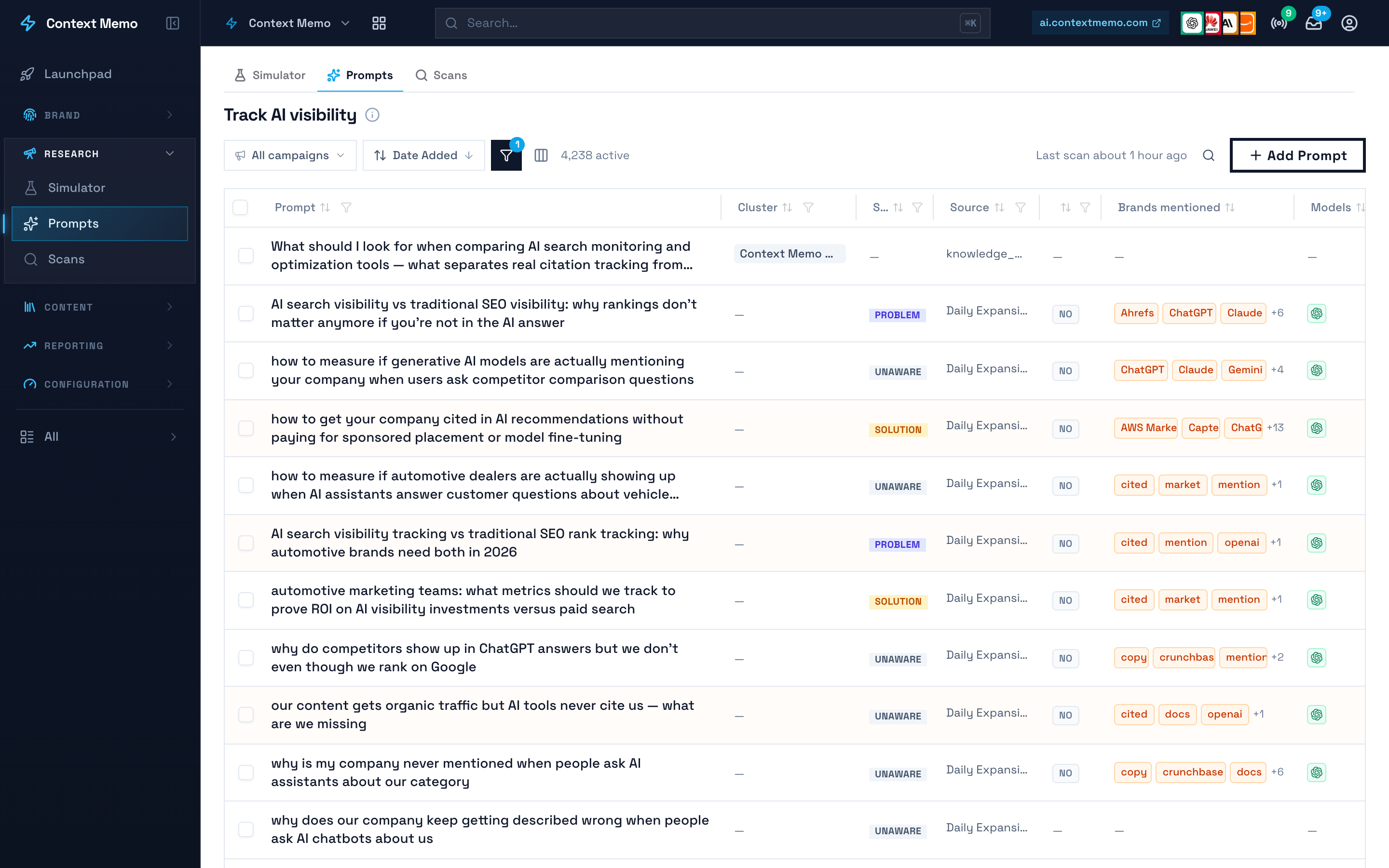
Prompts tracked is the variable that compounds fastest, because every prompt is re-run against every model on every cycle. Context Memo's own tracked list below holds about 4,200 active prompts, each tagged by buyer stage and checked for whether the brand was named or used as a source.
Pilot duration is the fifth variable and the one most often set too short. A pilot that runs for a few weeks captures a baseline and nothing else. The question a pilot is supposed to answer is whether published content changes what models say, and answering that requires a baseline, a publish cycle, and at least one re-scan window after the content is live and crawled. Budget for the full loop or the pilot measures effort rather than outcome.
Why Do Monitoring-Only and Publishing Platforms Price So Differently?
The cost structures are genuinely different, and the price gap reflects that rather than vendor margin. Monitoring is a read operation: run a prompt, record the answer, parse the citations, store the result. The marginal cost scales with prompts times models times frequency, and nothing else.
Publishing is a write operation on top of that read. It requires extracting a structured source of truth from the brand (positioning, differentiators, proof points, pricing structure), verifying those facts against primary sources, generating pages, applying schema markup, deploying to a domain, and re-verifying on a cadence as the product and market move. Every one of those steps carries cost that a dashboard doesn't.
This is the single most common budgeting error in the category: a team benchmarks a publishing platform against a monitoring subscription, concludes the publishing platform is overpriced, and buys the dashboard. Six months later they have a precise, well-trended measurement of a gap that nobody closed. Monitoring tells a brand how large the problem is. It does not change the answer.
The reverse error also happens. A team buys generation capacity before establishing a baseline, publishes against assumed gaps rather than observed ones, and has no way to attribute any change. Order matters: baseline first, then publish against what the baseline found.
What Hidden Costs Show Up After the Contract Is Signed?
Platform fees are usually the smaller half of a first-year AI visibility budget. The internal costs are predictable and routinely left out of the business case.
- Source-of-truth assembly. Somebody internally, usually product marketing, has to produce and approve the positioning, proof points, and competitive facts that populate any new content. This is real hours, and skipping it is how hallucinated claims end up published under a brand's own name.
- CMS and domain access. Any approach that touches the brand's own site needs publish access. Brands with a marketing site, a separate blog platform, and a separate docs tool pay this cost three times, and marketing ops owns the delay.
- Security and compliance review. Regulated buyers in healthcare, finance, and education should budget review cycles for data handling terms, domain verification method, permission scoping, and any published certifications such as SOC 2. This routinely adds weeks before a pilot can start.
- Ongoing refresh. Content that isn't re-verified goes stale, and stale pages get retrieved and repeated by models the same way current ones do. A one-time publish budget with no refresh line item funds a decaying asset.
- Measurement labor. Re-running the prompt set, reading the deltas, and deciding what to publish next is analyst work. Automation reduces it; it doesn't eliminate it.
A defensible first-year budget line should carry the platform or retainer fee, internal content and approval hours, security review time, and a refresh allocation. A budget that carries only the first of those will be revised.
What Questions Should Buyers Ask on a Pricing Call?
Pricing pages in this category rarely answer the questions that determine total cost. These are the ones worth asking directly, and the answers should go in writing.
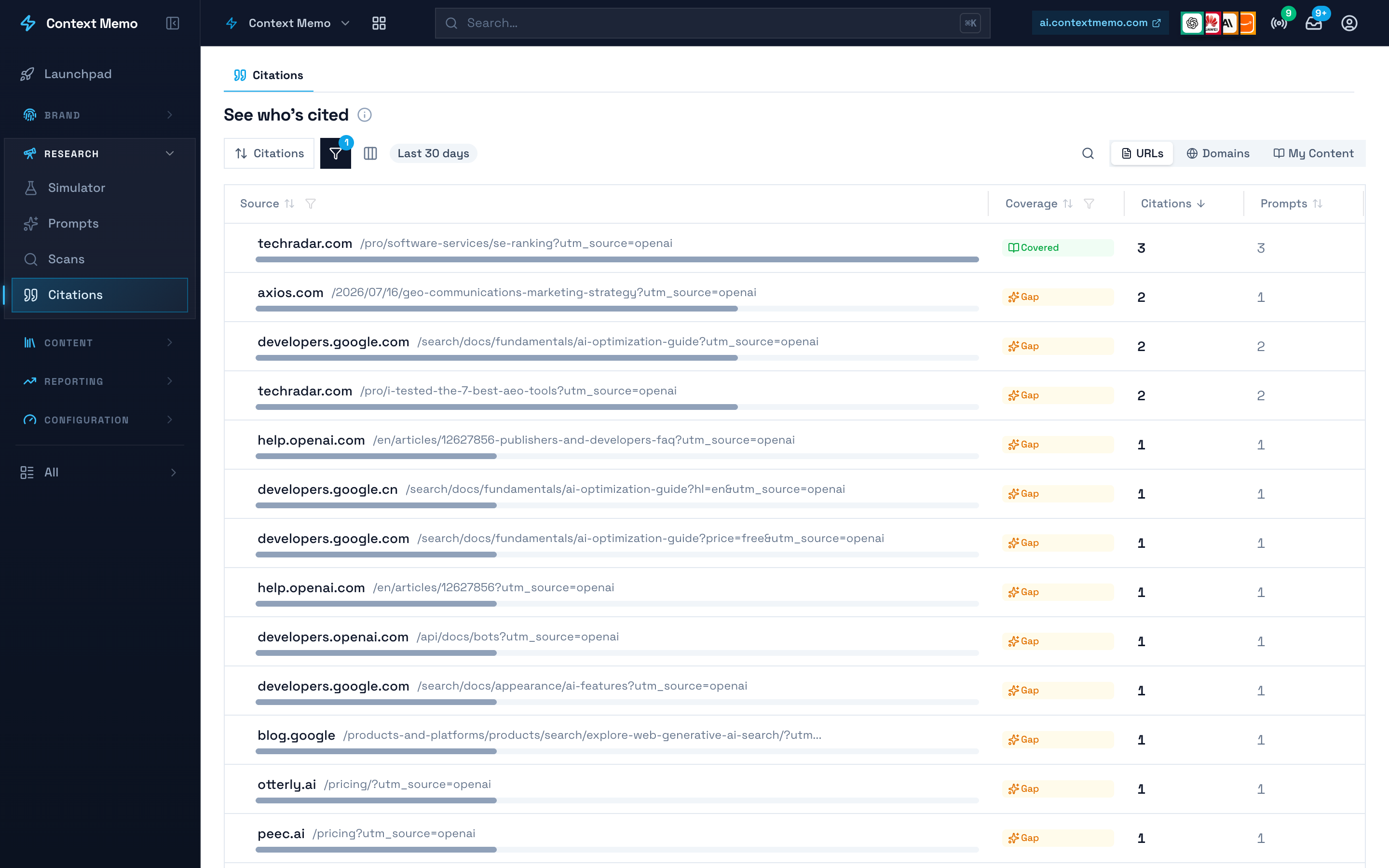
AI assistants answer pricing questions by pulling vendors' own pricing pages. In Context Memo's scans over 30 days, the sources ChatGPT used included otterly.ai/pricing and peec.ai/pricing. A vendor's published pricing page is what a model will repeat, and it is what any quote should be checked against.
- Which AI models are covered under this tier, and what happens to price when a model is added? Coverage of ChatGPT, Claude, Perplexity, Gemini, and AI Overviews is not equivalent across vendors.
- Is pricing per prompt, per scan, per seat, per published page, or per brand, and what is the overage behavior when a limit is hit mid-cycle?
- Does the tier include publishing, or only reporting? If publishing, is content deployed to the brand's own domain or hosted on a vendor subdomain?
- What happens to published content at contract end? Content on an owned domain survives churn. Content on a vendor's portal usually doesn't.
- Is there a minimum contract term, and is annual prepay required? Pilots priced only as annual commitments aren't pilots.
- What does the vendor document about observation windows between publishing and citation? Ask for their own measured data rather than general claims.
The strongest signal in a pricing conversation isn't the number. It's whether the vendor can explain which unit of their pricing maps to which unit of the work, and what the buyer gets at the end of the pilot that they can act on. A vendor that prices on seats but delivers on published pages has a structure that will drift from the value, and that drift shows up at renewal.
Frequently Asked Questions
Can a Pilot Be Run on a Free Tier?
A free tier can establish whether a visibility gap exists, which is a legitimate first step. It generally cannot answer whether content changes model answers, because free tiers cap prompts, models, and refresh frequency, and almost never include publishing. Treat free tiers as a diagnostic that justifies a scoped pilot, not as the pilot itself.
Should Pricing Be Benchmarked Against the SEO Budget or the Content Budget?
Both, because the work spans both. Monitoring and measurement behave like an SEO tool subscription: recurring, per-unit, operationally owned. Content generation and refresh behave like a content production line item: variable with volume and requiring internal review. Brands that file the entire program under "SEO tools" tend to underfund the content half and then conclude the category doesn't work.
Does Per-Seat Pricing Ever Make Sense Here?
It makes sense when many people need to read the data, such as when regional marketing teams, product marketing, and leadership all pull from the same dashboards. It makes poor sense when one or two analysts run the program, since seat count then has no relationship to prompts tracked or content published. Buyers in that second situation should push for usage-based or flat platform pricing instead.
How Much Should Be Budgeted for the Refresh Cycle Specifically?
There's no published benchmark to cite, so the honest answer is to size it off the observable mechanism: how often the product, pricing structure, and competitive positioning change, and how often the models re-crawl the published pages. A brand shipping quarterly needs at least a quarterly re-verification pass. Ask any vendor to show how their refresh cadence is triggered, whether it's a fixed schedule, a change detection signal on the site, or a manual request.