
Last verified: October 12, 2026
TL;DR
When buyers run their category research inside an AI assistant first, the website stops being the discovery surface and becomes the verification surface. Three things change materially: the questions a site has to answer shift from keyword topics to decision questions, the content has to be extractable as fact rather than written for ranking, and top-of-funnel traffic stops being a reliable measure of demand. Approaches to adapting range from monitoring-only tracking to manual content rewrites to automated structured publishing, and the useful distinction between them is whether they just report the gap or actually close it.
What Actually Changes on the Site When the First Answer Happens Elsewhere?
The function of the website changes before the content does. When a buyer asks an assistant "what are the best platforms for X under 500 employees," the assistant returns three to five named vendors with reasons to trust them, and the buyer arrives at those vendors' sites already holding an opinion. The page is no longer being read to learn the category. It's being read to confirm or disprove a claim the model already made.
That shifts what has to be above the fold and what has to exist at all. Gartner research cited in reporting on the 2026 buyer journey puts the point of first contact at 61% of the way through the journey, down from 69% in 2024, with the average buying cycle compressing from 11.3 months to 10.1 months. The same reporting notes shortlist win rates rising to 95% from day one, meaning late entry into a deal is close to impossible. A site built to educate a cold visitor over five page views is solving a problem the assistant already solved.
Three practical consequences follow. Gated education loses value, because the buyer got the education for free somewhere else. Verification assets gain value: named customer outcomes, security and compliance documentation, integration lists, implementation timelines, pricing structure. And the path from "I read the AI answer" to "I talked to someone" has to be short, because 82% of buyers trust peer testimonials and reviews over vendor claims, and the site's job is to supply the proof the model couldn't.
How Do You Find Out What AI Models Currently Say About a Brand?
A manual audit works and takes under an hour. Write 20 to 30 questions a buyer would actually type, in their language, not internal category jargon. Published audit methodology from one B2B consultancy groups these into five types: category discovery ("best [category] platforms for [buyer profile]"), direct comparison, solution explanation, evaluation criteria ("what should I look for in a [category] vendor"), and alternative discovery.
Run each question across the major assistants, then score each response on a simple scale: 0 if the brand isn't mentioned, 1 if it's named in a list, 2 if it's described with what it does, 3 if it's recommended for a specific buyer type. Total the scores, divide by the maximum possible, and that percentage is the baseline. Diagnostic data across 150+ B2B brands from that same consultancy shows the average company scoring 18 to 22 out of 100 on AI visibility, with most brands landing at 8 to 15% at first baseline. Brands with strong organic rankings and active content programs routinely score below 25, because content structured for keyword ranking isn't structured for retrieval.
The audit also produces something a dashboard alone won't: the actual language the model uses. If an assistant says a product doesn't integrate with a system it does integrate with, or describes pricing as unavailable, that's a specific, fixable factual error traceable to a specific missing or buried page.
What Separates the Approaches to Fixing It?
Four approaches exist, and they differ on who does the work, where the resulting content lives, and how often it gets refreshed. Those three variables predict most of the outcome.
| Approach | Where Content Lives | What It Produces | Refresh Pattern |
|---|---|---|---|
| Monitoring-only tracking | Nothing published | Prompt-level visibility and competitor citation reports | Recurring scans, daily or weekly |
| Manual rewrites or agency engagement | Brand's own site | Human-edited pages, editorial control of voice and claims | Project-scoped, stalls at end of engagement |
| Automated structured publishing | Brand's own domain | Schema-marked reference pages generated from a verified fact set | Continuous, on a set cadence |
| AI tracking bolted onto SEO tooling | Existing SEO pages | AI Overview tracking inside familiar rank reports | Tied to the existing SEO calendar |
Monitoring tells a team precisely how large the gap is and never narrows it. That's a real limitation, not a minor one: the deliverable is a chart. Manual rewrites produce the best editorial quality because a person judges every claim, but they go stale the moment positioning or pricing moves, and nobody is re-checking. Automated structured publishing solves cadence and scale, with one hard dependency: the fact-extraction has to pull from verified primary sources rather than inferring. Automation that guesses at positioning introduces exactly the hallucinated claims the program exists to fix. SEO suites with AI tracking added offer workflow continuity but usually cover AI Overviews more thoroughly than the chat assistants, so coverage should be confirmed against published documentation rather than assumed.
What Content Earns Citations, and What Gets Skipped?
Models retrieve and synthesize; they don't rank. That single mechanical difference explains most of what works. Five factors show up consistently in the published diagnostic work on this question.
- Topical depth over single posts. One 800-word category overview doesn't establish authority. Fifteen pieces covering methodology, measurement, tooling, benchmarks, and common failure modes does. Gaps in coverage get filled with someone else's content.
- Recency. Assistants weight recently published and updated content for fast-moving topics, because pricing changes, vendors get acquired, capabilities ship. A library that stopped publishing two years ago gets deprioritized.
- Explicit question-and-answer structure. FAQ format maps directly to how an assistant generates a response. FAQPage JSON-LD schema labels the content as built for question-answering.
- Transparent pricing and specs. When pricing is behind "contact us," assistants either skip the brand in pricing comparisons or note that pricing isn't public, which reads as a negative in a side-by-side. Published pricing structure, API docs, integration lists, and compliance posture (SOC 2, GDPR) are concrete facts a model can lift.
- Entity consistency across the web. Site, LinkedIn profile, review listings, company database entries, and press mentions all feed the model's understanding of what a brand is. Five different self-descriptions produce entity ambiguity and a hedged answer.
The uncomfortable one: content that honestly handles skeptical questions tends to get cited more than content that doesn't. Buyers ask assistants the questions they won't ask a rep. Is this actually different from the alternative. Does it really do that. What are the downsides. Comparison content that concedes where another option is stronger reads as a credible, non-defensive source. If only third-party reviewers address those questions, the category gets framed on their terms.
How Should Measurement Change?
Traffic volume stops being the headline number. If the education phase happens inside an assistant, the site may see fewer sessions from better-qualified visitors, which looks like decline in a dashboard built for the old funnel and looks like improvement in pipeline.
Four signals replace it. Self-reported attribution on demo and contact forms ("how did you first hear about us") captures AI-originated research that no analytics tool sees; answers naming an assistant are the clearest available evidence. Referral traffic from assistant domains captures the fraction of sessions where the model linked out. Branded search volume and direct traffic growth serve as proxies for off-site discovery. And citation share across a fixed prompt set, re-run on a schedule, measures the actual channel rather than its side effects.
Server logs add a signal most teams never look at: crawl and fetch activity from AI user agents, separated by model and by whether the request came from a scheduled crawl or a live user query. That distinguishes "the model has indexed this page" from "a buyer's question just pulled this page."
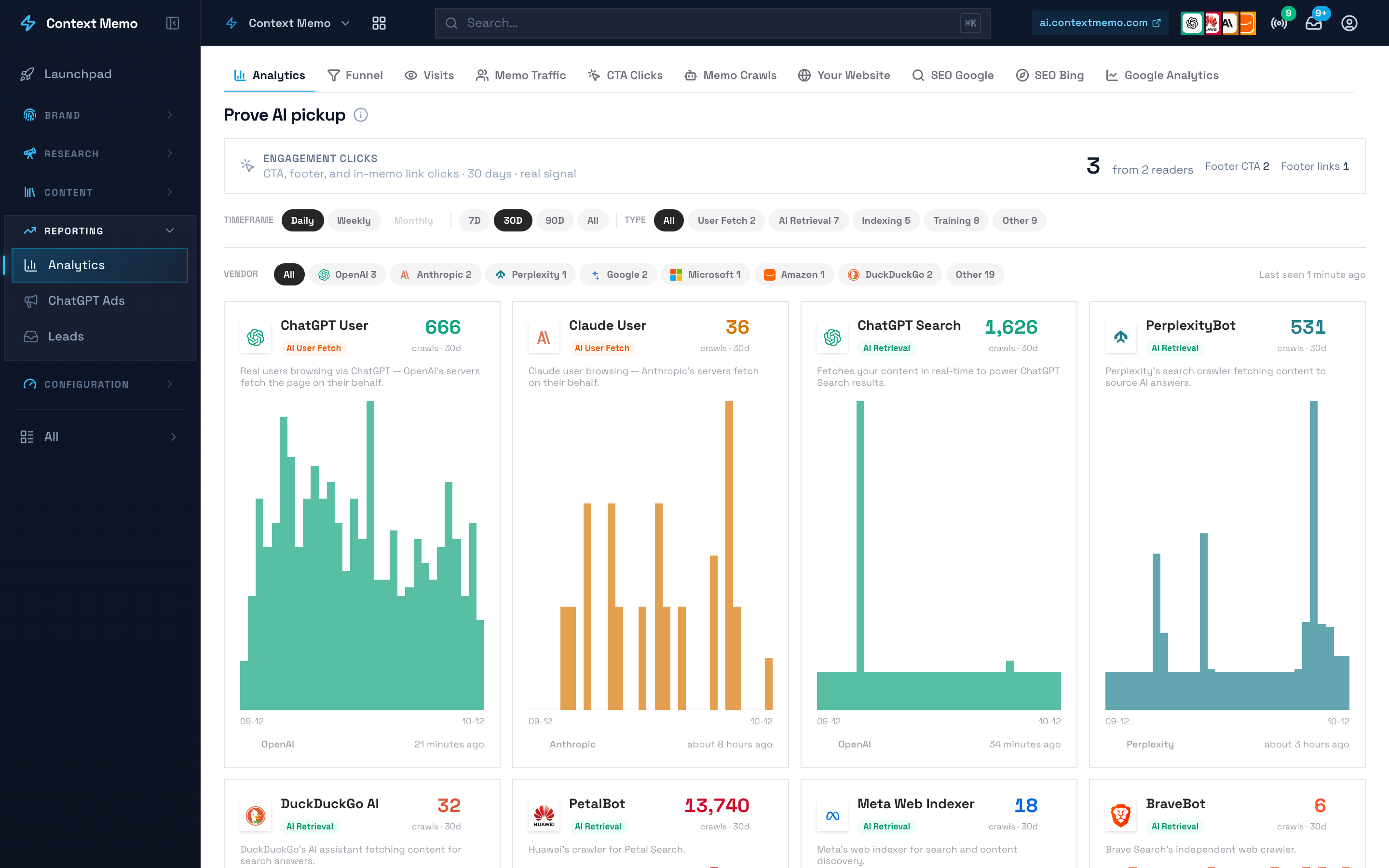
Two caveats on expectations. Semrush data from 2025 put AI-referral conversion at roughly 4.4 times the rate of organic search, which is why a small number of high-intent citations can move pipeline economics more than a large traffic gain. And gains erode: assistants re-crawl and re-synthesize on their own schedule, so a prompt set won once and never re-checked tends to drift back.
Frequently Asked Questions
How long does it take to appear in AI answers after publishing?
Timelines vary by model, crawl frequency, and the publishing domain's existing authority. One managed service reports first citations typically landing in 30 to 60 days. Retrieval-grounded answers can refresh on a different schedule than traditional ranking crawls, since some models fetch source pages at query time rather than relying only on a static index. Buyers should ask for documented observation windows rather than accepting general claims about speed.
Does this replace SEO?
No. Traditional SEO still governs classic search results and determines whether crawlers can discover a site at all, and clean technical SEO is what makes pages parseable for models in the first place. The two draw on the same content but operate on different mechanics: SEO optimizes for a ranked page, answer engine work optimizes for a cited sentence inside a generated answer. Most teams run them on separate cadences against the same content library.
Should the website still publish top-of-funnel educational content?
Yes, but for a different reader. Awareness-stage content now exists primarily to be the source an assistant pulls from, not the page a cold visitor lands on. That changes the format toward direct definitions, comparison tables, and explicit question headings, and away from long narrative introductions. Only bottom-funnel sales pages means the brand is absent from the discovery stage entirely.
What's the most common misconception?
That strong Google rankings carry over automatically. They don't. A page can rank on the first results page and still be invisible to an assistant if the facts are buried in narrative prose, locked in a PDF, rendered as an image, or contradicted elsewhere on the same domain.
Sources
- Gartner, B2B Buying Journey research (cycle length, point of first contact)
- The Pedowitz Group, AXO diagnostic data across 150+ B2B brands (AI visibility scoring methodology and baselines)
- Forrester, The State of Business Buying (AI in research vs. human trust)
- HubSpot, answer engine optimization and AI search visibility guidance
- Semrush, 2025 AI-referral conversion data