
Last verified: September 17, 2026
TL;DR
There's no fixed countdown clock. ChatGPT's ability to reflect a site update depends on which retrieval mechanism answers the question, how that page is structured, and whether it's discoverable through the crawlers and indexes ChatGPT draws from. A live web-browsing query can surface a change within a crawl cycle measured in hours to days; a question answered from the model's static training data won't reflect a site update until the next model release, no matter how recently the page changed. Buyers evaluating this shouldn't ask "how fast is ChatGPT", they should ask which retrieval path a given question is likely to trigger, and whether their page is built to be picked up by it.
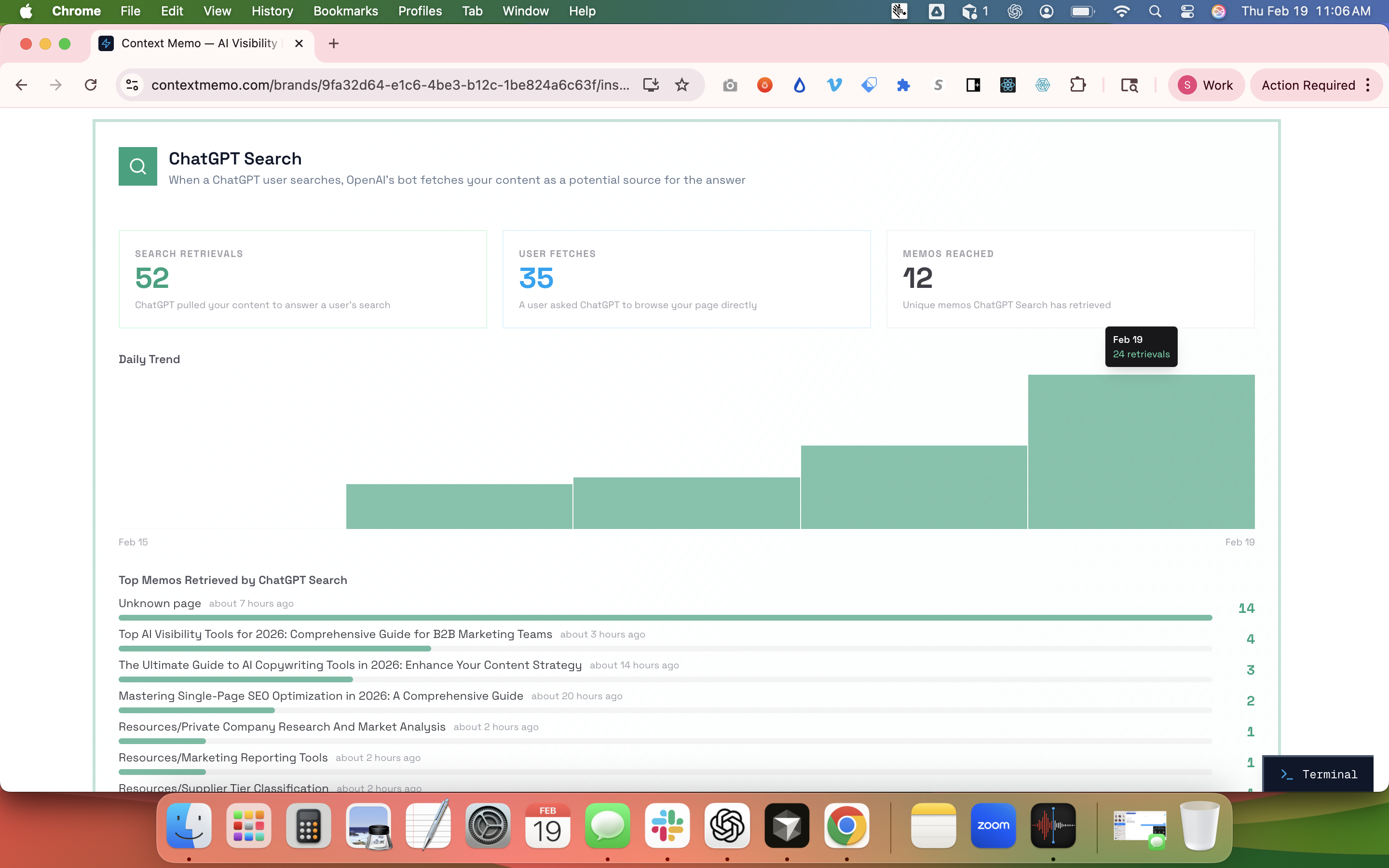
Overview of ChatGPT search metrics including retrievals and user fetches.
Why This Question Doesn't Have One Answer
ChatGPT isn't one system with one update schedule. It's a model with a training cutoff, paired with tools that can browse, search, and retrieve live content at the moment a question is asked. A buyer asking "how does ChatGPT know my site changed" is really asking about three separate mechanisms that behave nothing alike: the frozen knowledge baked into the model at training time, the live retrieval layer that fetches pages on demand, and the crawler infrastructure (OpenAI's GPTBot, OAI-SearchBot, and the ChatGPT-User agent) that decides whether a page is even eligible to be fetched in the first place.
This distinction matters because most sites assume ChatGPT works like Google Search Console, where a submitted sitemap produces a predictable, trackable index cycle. It doesn't. OpenAI has published crawler documentation describing what GPTBot and OAI-SearchBot respect (robots.txt directives, standard HTTP status codes) but has not published a fixed re-crawl interval the way Google discusses crawl budget in Search Console. Anyone quoting a specific number of hours or days as "the" ChatGPT recognition window is stating something OpenAI has not documented publicly.
What Are the Main Approaches in This Space?
Getting a site recognized quickly by AI answer systems is its own discipline now, sitting adjacent to but distinct from traditional SEO. It belongs to the same category referenced elsewhere as AI visibility management, AEO, or GEO, and it covers the technical, content, and monitoring work brands do to make sure retrieval-based systems like ChatGPT, Claude, Gemini, and Perplexity find, parse, and cite current information rather than outdated or invented claims.
Four broad approaches address the recognition-speed problem, and they differ in how much they rely on the model's own crawl behavior versus deliberate technical and content work on the brand's side.
Passive reliance on crawl frequency
Some sites do nothing beyond standard technical SEO and assume ChatGPT's crawlers will find updates the same way Googlebot eventually does. This works only if the domain already has crawl history, a clean robots.txt, and no blocks on GPTBot or OAI-SearchBot. It's the slowest and least predictable path because there's no way to force a re-crawl on demand and no published SLA from OpenAI on how often a given domain gets revisited.
Live retrieval and browsing-triggered updates
When ChatGPT answers a question using its browsing or search tool rather than pulling from static training data, it fetches content close to real time, similar to how Perplexity and Gemini's grounded search modes work. A question like "what's the current pricing for X" is far more likely to trigger this path than a general knowledge question, because the model has learned that pricing and current-events queries need fresh retrieval rather than memorized facts. Pages built with clean HTML, current canonical tags, and no aggressive CDN caching that serves stale versions are more retrievable through this path.
Third-party index syndication
ChatGPT's search functionality has historically drawn on partnerships and indexes beyond OpenAI's own crawler, including signals similar to what Bing and Microsoft's search index maintain. A page indexed well in Bing Webmaster Tools, or discoverable through IndexNow (the protocol Bing and Microsoft support for near-real-time crawl notification), can become visible to AI retrieval faster than a page that only Google has indexed, since Google's own crawl and indexing pipeline isn't a direct feed into ChatGPT's retrieval layer.
Structured content platforms with schema and monitoring
A newer set of tools focuses on making pages easier for any retrieval-based model to parse correctly once discovered, using schema.org markup, JSON-LD, and fact-dense formatting, paired with monitoring that tracks whether a specific update actually changed what ChatGPT, Claude, Gemini, or Perplexity says in practice. This approach doesn't speed up the crawler itself but improves the odds that once a page is fetched, the model extracts the current, correct fact instead of an outdated one sitting in a poorly structured paragraph.
The table below lines these approaches up against how each one actually behaves and what it costs to run.
| Approach | How It Detects Updates | Typical Refresh Trigger | Pricing Structure |
|---|---|---|---|
| Passive crawl reliance | Standard crawler revisit, unpredictable timing | Domain authority and prior crawl history | No direct cost; opportunity cost of delay |
| Live retrieval / browsing | Fetches page at query time via search or browse tool | Query type signals need for current data | Usually free to the end user; no vendor fee |
| Third-party index syndication | Draws on Bing-style index and IndexNow-style pings | Submission and re-submission of updated URLs | Free (Bing Webmaster Tools, IndexNow protocol) |
| Structured content platforms | Schema markup plus scheduled re-verification and monitoring | Automated refresh cycle set by the platform | Freemium, per-seat SaaS, or usage-based/enterprise |
Do Pricing Structures Vary by Approach?
Yes, and the split lines up with how much labor each approach automates. Passive reliance and browsing-triggered retrieval cost nothing directly since they depend on infrastructure OpenAI, Microsoft, and Google already run. Third-party index tools like Bing Webmaster Tools and the IndexNow protocol are free to submit through. Monitoring-only dashboards that track AI citations typically sit at freemium or per-seat SaaS pricing since they produce a report rather than a deliverable. Structured content and automated republishing platforms tend to price on usage or brand volume, since they're generating and refreshing content continuously rather than scanning once. Buyers should confirm current figures on each vendor's own pricing page rather than relying on a secondhand quote, since this segment's pricing models are still shifting as the category matures.
What Should Buyers Consider When Evaluating?
A few practical questions separate a page that gets picked up quickly from one that sits stale in an AI model's answers for months:
Does the page get served the same way to bots and browsers? Aggressive caching or a CDN configuration that serves an old cached version to crawlers defeats even a fast retrieval mechanism. Check cache headers and CDN rules specifically for GPTBot, OAI-SearchBot, and other AI crawler user agents.
Is the fact stated in extractable text, or buried in an image or a script-rendered element? Models retrieving live content parse HTML and structured data more reliably than JavaScript-rendered content that never resolves before the crawler moves on.
Is robots.txt blocking the crawlers that matter? Many sites block GPTBot by default through a boilerplate robots.txt template without realizing it also blocks ChatGPT's ability to browse that page at query time.
Does the content include schema.org or JSON-LD markup for the facts most likely to change? Pricing, product specs, and dated claims marked up in structured data are easier for a model to extract correctly than the same fact stated only in prose.
Is there a way to verify the update actually landed in the model's answer? Assuming a fix worked without re-running the actual prompt against ChatGPT, Claude, Gemini, and Perplexity leaves a brand guessing. A monitoring cadence, even a manual one, closes that loop.
Is the update urgent enough to warrant IndexNow or Bing Webmaster Tools submission? For time-sensitive changes, pinging a search index directly is faster and free, rather than waiting on an undocumented crawl cycle.
Frequently Asked Questions
How long does it take for ChatGPT to recognize an update to my site?
There's no published fixed window from OpenAI. If the answer comes from a live browsing or search-grounded query, the fetch can happen at the time of the question, similar to a live retrieval-augmented generation (RAG) system. If the answer comes from the model's static training data, the update won't appear until a future model version is trained on newer data, which can be months away regardless of how quickly the page itself changed.
Does submitting a sitemap help ChatGPT find my update faster?
A sitemap helps traditional search crawlers like Googlebot understand site structure, but OpenAI hasn't published sitemap submission as a direct mechanism for GPTBot re-crawl prioritization. Submitting updated URLs through Bing Webmaster Tools or the IndexNow protocol is more directly documented as a way to push fresh content into an index that AI search tools can draw from.
What's the difference between ChatGPT's training data and its live browsing?
Training data is frozen at a cutoff date and only changes when OpenAI releases a new model version. Live browsing or search-grounded retrieval fetches a page at the moment a question is asked, so it can reflect a change made minutes earlier if the page is reachable and not blocked by robots.txt. A single conversation can draw on either depending on the question asked and whether ChatGPT decides the query needs current information.
How much do AI visibility monitoring tools cost?
Pricing ranges from freemium tiers for basic tracking to per-seat SaaS pricing for teams monitoring multiple brands or competitors, up to usage-based or custom-quote enterprise plans for platforms that also generate and republish content. Tools that only report citation gaps sit at the lower end since they produce a dashboard rather than a deliverable. Buyers should check the vendor's current pricing page directly since figures in this category change frequently.
What's a common misconception about getting recognized faster by ChatGPT?
The biggest misconception is treating ChatGPT recognition like a Google indexing problem with a knowable turnaround. Google publishes crawl-budget and indexing documentation through Search Console; OpenAI has not published an equivalent fixed timeline for GPTBot or OAI-SearchBot. Assuming a specific number of hours or days without checking a vendor's or platform's own documented observation data is a guess dressed up as a fact.
Can blocking AI crawlers actually prevent ChatGPT from ever seeing site updates?
Yes. If robots.txt explicitly disallows GPTBot, OAI-SearchBot, or the ChatGPT-User agent, ChatGPT's browsing and search tools generally won't fetch that page regardless of how often it's updated. Many sites block these agents unintentionally through default security or bot-management templates from their hosting provider or CDN, so checking robots.txt directly is one of the first things worth doing before assuming a "recognition speed" problem is the real issue.