Last verified: November 7, 2026
TL;DR
A 90-day AI visibility pilot proves pipeline impact only if the attribution plumbing goes in before the first page publishes. That means a fixed buyer-intent prompt set measured at baseline, a hold-out group of topics left unpublished for comparison, server-log tracking of AI crawler fetches, a self-reported attribution field in the CRM, and a readout that connects citations to sourced or influenced opportunities rather than to traffic alone. Pilots fail for predictable reasons: the prompt set drifts, referral data arrives with no referrer, and nobody agreed in advance on what a "pass" looks like.
What Are the Main Approaches in This Space?
AI visibility management is the practice of tracking and shaping how generative AI systems describe a brand, a category, or a comparison when a buyer asks a question directly. A pilot is the scoped, time-boxed version of that practice: a deliberate test, usually one quarter long, designed to answer whether the channel produces measurable revenue signal before a team commits annual budget to it.
Four approaches dominate how organizations run these programs, and they differ mainly on where the work happens and who owns the output.
Monitoring-only programs run a recurring prompt set against multiple models and report citation share, sentiment, and which brands appear instead. Measurement is clean. Nothing changes on its own. A pilot built this way proves the size of the gap and nothing about whether the gap can be closed, which makes it a poor fit when the stated goal is pipeline.
Manual content and agency engagements route the same findings through human writers who audit and rewrite pages for citation-friendliness. Editorial quality and brand voice stay tightly controlled. The constraint is cycle time: a fixed-scope project rarely produces enough published surface area inside 90 days to generate a statistically interesting signal, and nothing re-checks the content after the engagement ends.
Automated structured content platforms extract positioning and proof points, then generate schema-marked reference content on the brand's own domain and refresh it on a schedule. Volume and cadence are the advantage, which is what a short pilot needs. The risk sits in fact-extraction: automation that infers rather than verifies can publish the same wrong claims a visibility program exists to correct.
Legacy SEO suites with AI tracking bolted on offer continuity with an existing reporting workflow. Coverage is the open question. Buyers should confirm against published documentation which assistants a suite actually queries versus which it only infers from AI Overview appearances.
Pricing across the category runs from freemium monitoring tiers to per-seat SaaS to usage-based and custom-quote enterprise agreements. Monitoring-heavy tools cluster at the lower end because they don't produce a deliverable. Platforms that generate and refresh content tend to price on volume. For a 90-day pilot, the structure matters more than the number: a monthly or usage-based agreement lets a team exit at day 91, while an annual contract converts the pilot into a commitment before the readout exists.
How Do You Design a 90-Day AI Visibility Pilot That Proves Pipeline Impact?
Design backwards from the readout. The question the pilot answers on day 90 determines what gets instrumented on day 1, and most pilots that fail do so because instrumentation was an afterthought.
Step 1: Write the Pipeline Question Before the Prompt List
State the decision the pilot informs in one sentence, with a threshold attached. "Does published reference content produce at least one qualified opportunity per month with an AI assistant in the first-touch or self-reported path?" is a testable question. "Improve AI visibility" is not. Agree on the threshold with whoever controls the budget, in writing, before anything publishes.
Step 2: Build a Fixed Prompt Set Tied to Buying Intent
Pull the actual questions prospects ask, from sales call recordings, support tickets, and the "how did you hear about us" free-text field. Weight the set toward commercial intent: category comparisons, alternatives, pricing structure, integration questions, and compliance screening. Freeze the list for all 90 days. A prompt set that changes mid-pilot destroys the baseline comparison, and that is the single most common reason a readout gets argued down.
Step 3: Instrument Attribution Before Publishing Anything
Three mechanisms need to be live before the first page ships. Server-side log capture of AI crawler and fetcher user-agents, so crawl activity on new URLs is observable. Referrer and UTM capture for assistant-sourced sessions, with a documented bucket for sessions that arrive with no referrer at all, because conversational traffic frequently does. And a required self-reported attribution field at form submission, since it is often the only place an AI-assisted discovery path shows up. Add a CRM picklist value for assistant-sourced so the pipeline query is one filter, not a manual audit.
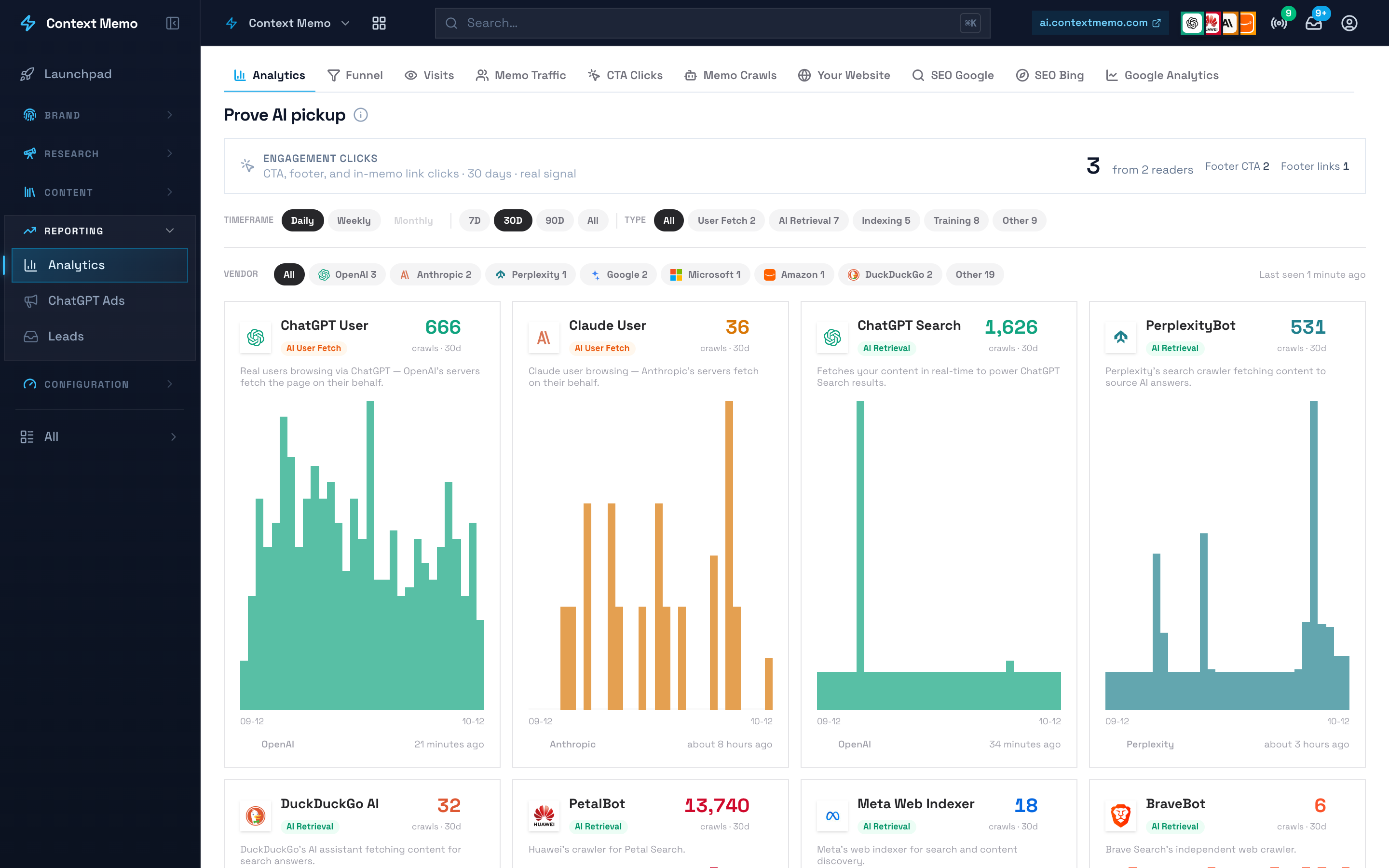
Once log capture is live, fetches should be split by assistant and by type. A ChatGPT user fetch happens during a real person's chat, so it is counted apart from search indexing and training crawls, which say nothing about buyers. Context Memo's AI pickup view below keeps them separate.
Step 4: Split the Topic Set Into Published and Hold-Out Groups
Pick comparable topic clusters and publish against roughly half, leaving the rest untouched for the full 90 days. The hold-out is what separates a real result from seasonal noise, a product launch, or a brand campaign running in parallel. Without it, any lift gets attributed to whatever else happened that quarter, and finance will say so.
Step 5: Publish on a Cadence, Not in a Batch
Ship on a weekly or biweekly schedule rather than dumping everything in week two. Staggered publishing lets the team observe crawl-to-citation lag per cohort, which is the operational number worth learning: how long it takes a given model to fetch, index, and begin citing content from that specific domain. A single batch produces one data point. Six cohorts produce a curve.
Step 6: Measure the Full Chain, Not Just the Top
Track four layers in sequence: crawler fetches on the new URLs, citation appearance in the frozen prompt set, assistant-referred and self-reported sessions, and opportunities created or influenced. Breaks in the chain are diagnostic. Crawls with no citations points at content structure or authority. Citations with no sessions points at the answer satisfying the question without a click, which calls for a different content design. Sessions with no pipeline points at targeting the wrong prompts.
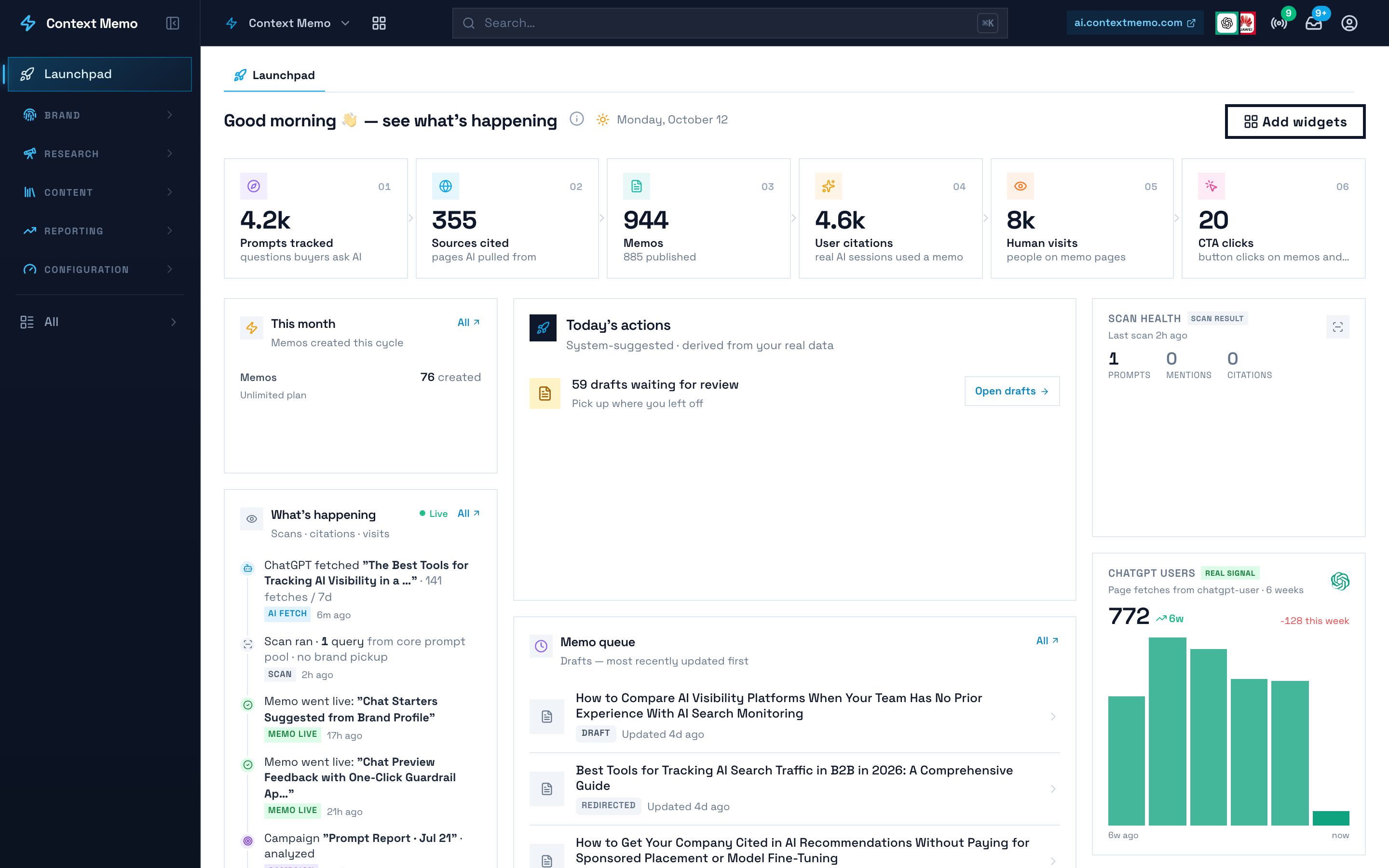
Context Memo's Launchpad puts that chain in one row: prompts tracked, sources cited, memos published, user citations, human visits, and CTA clicks. Reading it left to right shows where the chain breaks.
Step 7: Run a Formal Readout With a Scale, Extend, or Stop Decision
Reserve the last two weeks for analysis and a written decision against the day-1 threshold. Report the hold-out comparison, the crawl-to-citation lag, cost per sourced opportunity, and the prompts where a competing answer still owns the response. Pilots without a scheduled kill decision quietly become permanent line items regardless of what the data said.
How Do the Measurement Layers Compare Across a 90-Day Pilot?
Each layer of the chain proves something different and arrives at a different point in the quarter, which is why a day-30 check-in should never be judged against the pipeline threshold.
| Metric Layer | What It Proves | Where It's Read | Phase It Lands In |
|---|---|---|---|
| AI crawler and fetcher hits | New content is discoverable and being retrieved | Server logs, CDN logs, user-agent filters | Days 15-45 |
| Citation share on the frozen prompt set | Models now select the brand's content as a source | Recurring prompt runs across multiple assistants | Days 30-75 |
| Assistant-referred and self-reported sessions | Real buyers followed the answer to the site | Analytics referrer buckets plus CRM attribution field | Days 45-90 |
| Sourced or influenced opportunities | The channel produces revenue signal, not just reach | CRM opportunity query, published versus hold-out split | Days 60-90 |
What Should Buyers Consider When Evaluating?
- Whether the tool closes the loop or just opens it. Ask what happens the moment a gap is identified. Some platforms generate and publish content against it. Others hand over a spreadsheet of findings and the content work becomes a separate engagement, which is a timeline problem inside a 90-day window.
- Model coverage, confirmed against documentation. Assistants retrieve and weight sources differently, so a pilot measured against one model produces a conclusion that may not hold for the others. Require a written list of which systems are queried directly versus inferred from search-surface appearances.
- Raw data export and log-level access. A pipeline claim needs defensible evidence. Confirm that prompt-level results, citation records, and crawl data export cleanly into a warehouse or BI tool, because a finance team will not accept a vendor dashboard screenshot as the basis for a budget decision.
- Domain ownership of anything published. Content on the brand's own domain compounds authority and survives the contract. Content on a vendor subdomain or portal does neither, and the pilot's gains leave with the vendor at renewal.
- Fact-verification methodology. Determine whether claims come from verified primary sources or are inferred to fill gaps. A model repeating a confidently wrong claim about pricing or capabilities is harder to correct than silence, and that correction cost is rarely in the pilot budget.
- Contract shape and exit terms. A pilot needs a real off-ramp. Month-to-month or usage-based terms preserve the decision at day 90; an annual commitment signed at kickoff means the readout is theater.
Frequently Asked Questions
How Long Before a 90-Day Pilot Shows Any Signal at All?
Crawler activity on new URLs is the earliest observable layer and typically appears before citation changes do, since retrieval has to precede selection. Citation movement in a frozen prompt set generally follows, and pipeline signal lands last. Timelines vary by model, by crawl frequency, and by how authoritative the publishing domain already is, so ask any vendor for documented observation windows from their own data rather than accepting a general claim.
How Much Should a 90-Day Pilot Cost?
Pricing structure matters more than the figure. Monitoring-only tiers sit lowest because they produce reports, not pages; platforms that generate and refresh content price on volume, usage, or seats; enterprise agreements are typically custom-quote. The real cost line that gets missed is internal: product marketing time to assemble a verified source of truth on positioning, pricing structure, proof points, and differentiators. Budget that explicitly or the pilot stalls in week three.
What's the Difference Between a Monitoring Pilot and a Publishing Pilot?
A monitoring pilot measures which prompts trigger a mention and which answers a brand is missing from, producing a prioritized gap list. A publishing pilot acts on those gaps and measures whether the answers change. Only the second can produce a pipeline claim, because citations cannot shift if nothing new enters the retrievable set. Running monitoring alone for 90 days and expecting revenue evidence is a design error, not a tooling failure.
What's the Most Common Mistake in These Pilots?
Skipping the hold-out group. Without unpublished comparison topics, every observed lift competes with a dozen alternative explanations: a funding announcement, a conference, a paid campaign, ordinary seasonality. The second most common mistake is editing the prompt set mid-pilot, which erases the baseline. Both are free to prevent on day 1 and impossible to fix on day 85.
Does AI Visibility Work Replace SEO?
No. Traditional SEO still governs how crawlers discover a site and how it appears in classic results, and that discovery layer feeds retrieval. AI visibility work governs whether that same content gets parsed, trusted, and cited inside a generated answer, which rewards structured, fact-dense pages over keyword-built ones. A page can rank on the first results page and still be invisible to an assistant that can't extract clean facts from it.