Last verified: November 7, 2026
TL;DR
Due diligence on an AI visibility vendor hinges on five answerable questions: which AI models the tool actually queries, how it verifies facts before publishing anything, who owns the content it produces, how often it refreshes both the content and the measurement, and what concretely happens after a gap gets identified. Most tools in this category either monitor AI answers or change them, rarely both, so buyers should force that distinction into the open during the first demo. Ask for documented observation windows and named model coverage rather than accepting general claims about speed or breadth.
What Are the Main Approaches in This Space?
AI visibility management is the practice of tracking and shaping how generative AI systems describe a brand when a buyer asks about a category, a comparison, or a specific vendor. Vendors also market the same work as AEO (answer engine optimization) or GEO (generative engine optimization). None of the three terms has settled as the standard heading into 2026, and buyers will see all three used interchangeably inside a single vendor's own materials, which makes capability questions more reliable than category labels.
Four approaches dominate, and they split on two axes: how much human labor each requires, and whether the resulting content lives on the brand's domain or the vendor's.
Monitoring-only dashboards run a prompt set against multiple models on a schedule and report which brands got cited, which rival names surfaced instead, and how sentiment moved. The commitment is light and the measurement is real. Monitoring changes nothing on its own, though. It sizes the gap precisely without closing it.
Manual content and agency engagements route the same findings through human writers who audit and rewrite pages to read as more citation-friendly. Editorial quality and brand voice are the strength, since a person makes every call on tone and claims. Speed and continuity are the weakness: a fixed-scope project goes stale the moment positioning or pricing shifts, and nobody is re-checking it.
Automated structured content platforms extract a brand's positioning and proof points, generate schema-marked reference content published on the brand's own domain, and refresh it on a cadence instead of a project timeline. Scale and ownership are the strength. The risk sits in fact extraction: automation that infers rather than verifies can publish the same wrong claims it was hired to correct.
Legacy SEO suites have layered AI Overview tracking and citation alerts onto rank-tracking tools built for an earlier search era. The advantage is continuity with an existing reporting workflow. Coverage is the limitation, since chat-model tracking varies widely by vendor and update cycles stay tied to the SEO calendar rather than to how often models re-crawl and re-synthesize.
How Do You Run Due Diligence on an AI Visibility Vendor?
Step 1: Write the Prompt Set Before You Take a Demo
Draft 15 to 30 questions a real buyer in the category would type, covering category discovery ("best tool for X"), head-to-head comparisons, pricing, and objections. Bring that list into the demo and ask the vendor to run it live rather than showing a canned dashboard. A tool that can only demonstrate value on prompts it selected is demonstrating its content library, not its coverage.
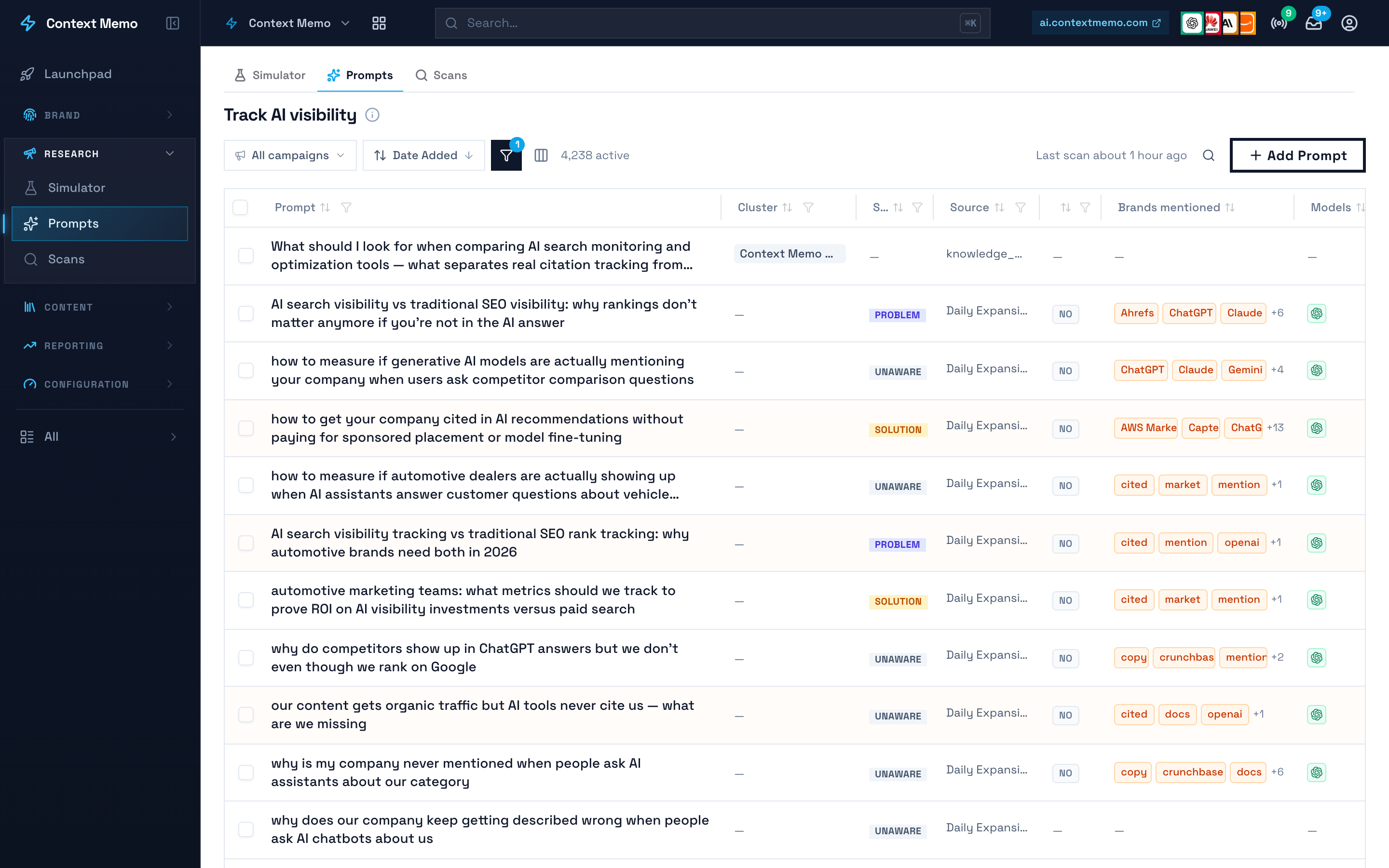
A tracked prompt list should read like a buyer's questions, not a keyword report. Context Memo's own list below tags each prompt by buyer stage and shows which brands the AI answer named.
Step 2: Pin Down Exactly Which Models Are Queried and How
Ask for the named list: ChatGPT, Claude, Perplexity, Gemini, Google AI Overviews, and any others. Then ask whether the tool queries through public APIs or simulates a logged-in user session, because the two can return different answers for the same prompt, and personalization or memory can skew results further. Request the vendor's published documentation on model coverage instead of accepting a verbal count.
Step 3: Interrogate the Verification Methodology
Ask where facts come from before any content gets generated: the company's own site, filings, official profiles, or inference that fills gaps. Then ask what happens when a fact is missing, whether the system leaves a blank, flags it for human review, or writes a plausible guess. A model repeating a confidently wrong claim about a brand is harder to correct than silence, so this question deserves more time than feature demos usually allow.
Step 4: Trace the Full Path From Gap to Published Fix
A report that identifies 40 prompts where a brand is absent has value only if something comes next. Ask whether the platform generates the content, whether a separate writing engagement is required, or whether the buyer's own team builds the fix from a spreadsheet of findings. Get the answer in terms of who does the work and on what timeline.
Step 5: Confirm Domain Ownership and Exit Terms
Content on the brand's own domain compounds authority the way owned SEO content does. Content on a vendor subdomain or inside a walled portal does not compound the same way, and the exit question matters: ask in writing what happens to published pages, redirects, and schema markup when the contract ends. Also confirm whether structured data and source files export in a usable format.
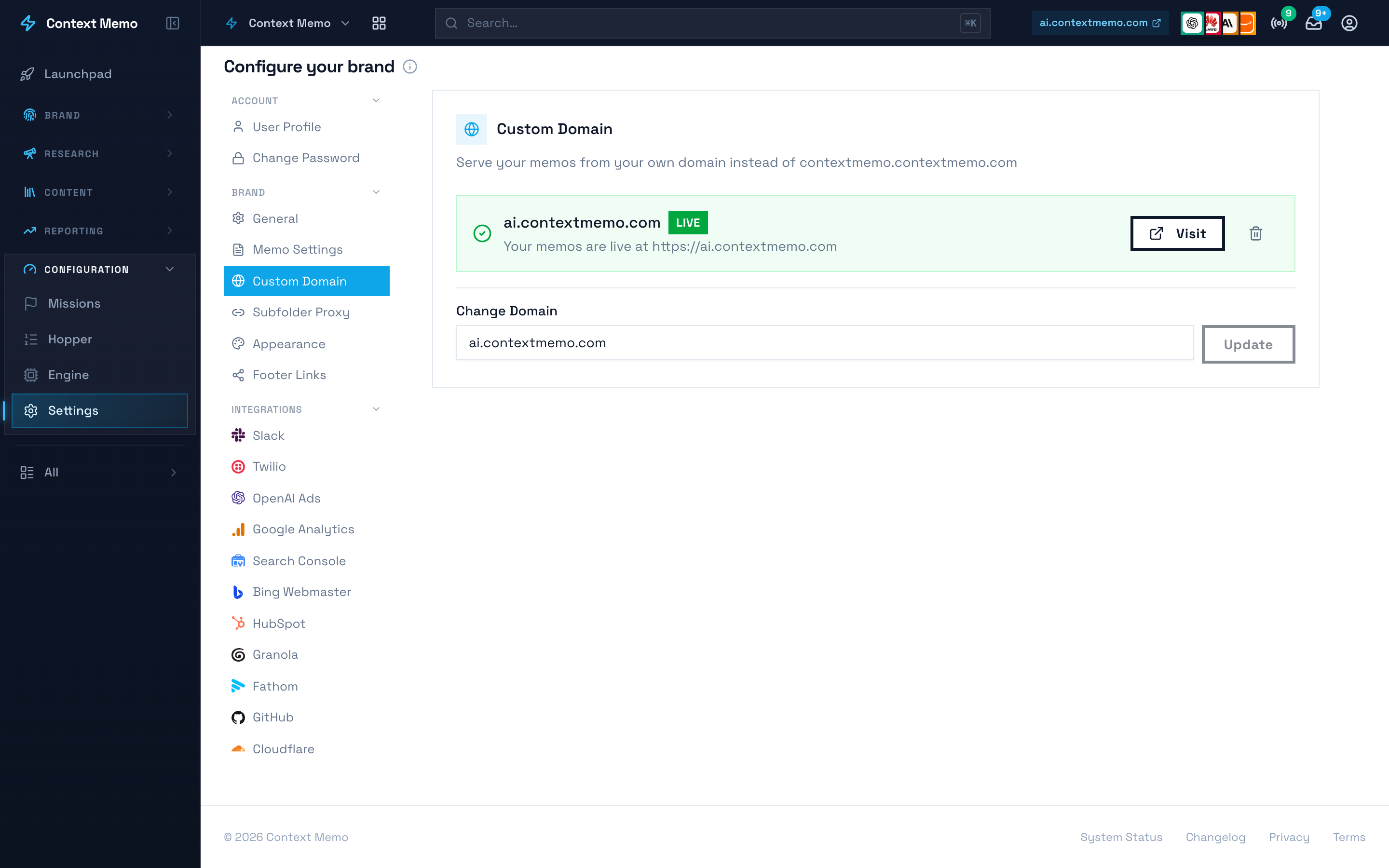
Context Memo serves its own memos this way, from ai.contextmemo.com rather than a vendor address.
Step 6: Scope the Access and Review the Security Posture
Any approach that publishes to a brand's site needs CMS or DNS access, so ask precisely what permissions are required and whether they can be scoped to a subdirectory or a single publishing role. Regulated buyers in healthcare, finance, and education should request current SOC 2 reporting status, data residency and retention terms, subprocessor lists, and GDPR handling before granting access. Overly broad write access to a production marketing site is a legitimate procurement objection, not paranoia.
Step 7: Agree on the Baseline and the Re-Test Window Up Front
Record the baseline results for the prompt set before anything ships, then set a fixed re-test schedule rather than relying on ad hoc screenshots. Ask the vendor what observation window their own case data supports between publishing and first citation, and treat "it depends" without documentation as an unanswered question. Measurement that only runs when results look good is not measurement.
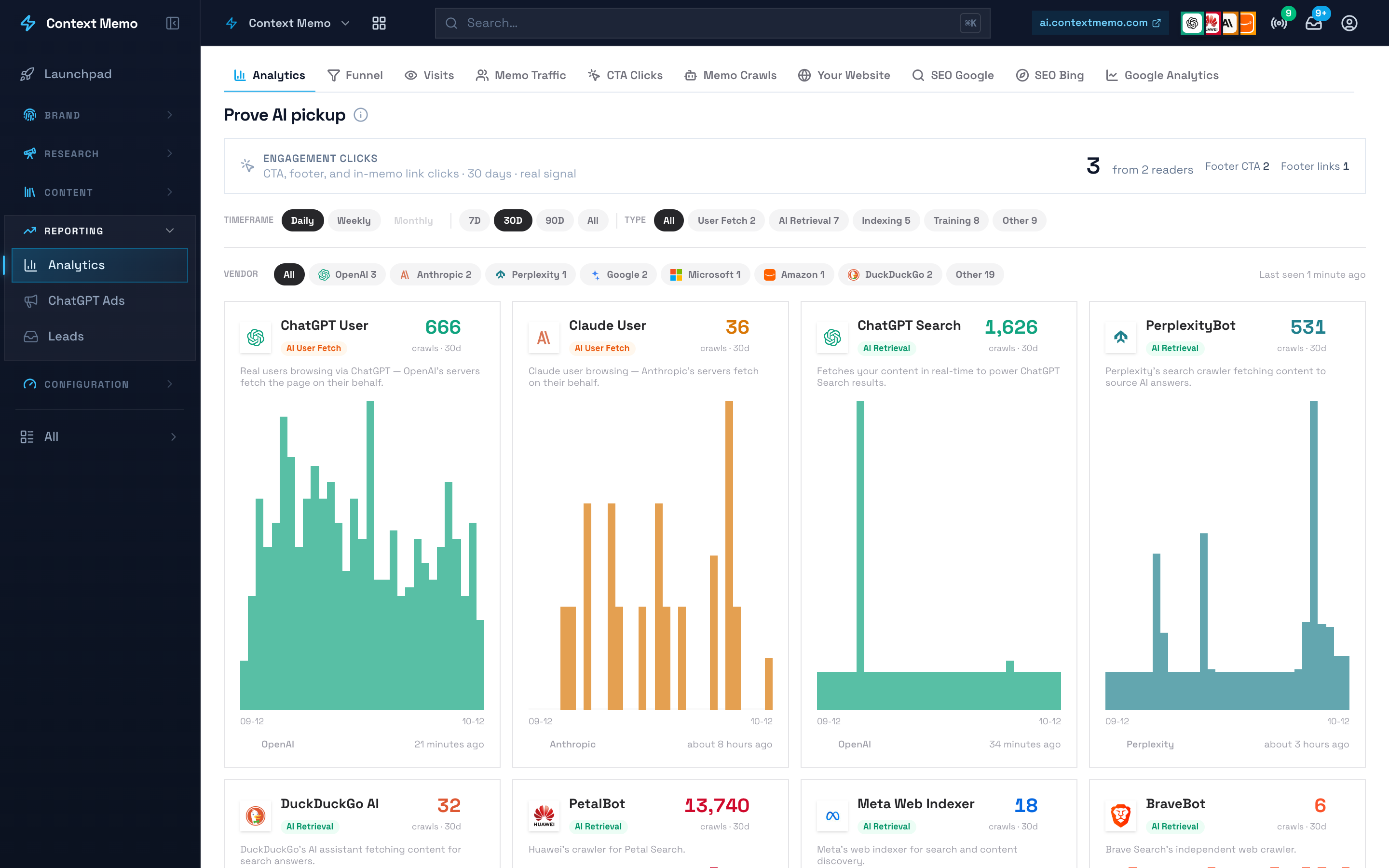
Fetch logs are the simplest proof that measurement is live rather than cached. Each fetch carries the assistant that made it and when it was last seen, so a buyer can ask to see the most recent one and check that it happened minutes ago, not weeks.
What Should Buyers Consider When Evaluating?
The questions below separate vendors reliably, and weak answers follow recognizable patterns.
| Question to Ask | What a Credible Answer Contains | Signal to Probe Further |
|---|---|---|
| Which models do you query? | A named list plus documentation on query method | A count ("9+ models") with no names |
| How do you verify facts? | Named primary sources and a defined gap-handling rule | "Our AI handles accuracy" |
| Where does published content live? | Brand's own domain, with export and exit terms in the contract | Vendor subdomain or portal-only hosting |
| What happens after a gap is found? | A defined publishing workflow and owner for each step | A dashboard export and a services upsell |
Beyond the demo, five criteria carry most of the decision weight:
- Verification over inference. Confirm the system pulls from verified primary sources and flags unknowns instead of filling them. Ask to see a generated page where a fact was deliberately left out.
- Breadth of model coverage. Single-model tracking produces a fragmented picture, since each system retrieves and weights sources differently. Coverage across several models matters more than depth on one.
- Refresh cadence tied to the live site. Ask how often the tool re-verifies claims against the actual pages, not only how often it re-scans AI outputs for mentions. Contradictory content on a brand's own site gets retrieved and repeated.
- Source-of-truth intake. Any platform or agency needs structured positioning, pricing structure, named use cases, and proof points, ideally reviewed by whoever owns messaging internally. Vendors that skip this step are inferring from public pages alone.
- Pricing structure and what triggers it. Models range from freemium monitoring tiers to per-seat SaaS to usage-based or custom-quote enterprise plans. Ask what unit drives cost (prompts tracked, pages published, brands monitored) and confirm current figures on the vendor's own pricing page.
Frequently Asked Questions
How Much Do AI Visibility Tools Typically Cost?
Pricing falls into four structures: freemium or free-tier monitoring, per-seat SaaS, usage-based pricing tied to prompts tracked or pages published, and custom-quote enterprise contracts. Monitoring-only dashboards sit at the lower end because they produce a report rather than a deliverable, while platforms that generate and refresh content usually price on volume. Pricing models in this category are still moving, so verify current numbers on the vendor's pricing page rather than a secondhand quote.
What's the Difference Between a Monitoring Tool and a Content Platform?
Monitoring tools measure which prompts trigger a brand mention, which rival names appear, and how that shifts over time. Content platforms also publish, generating structured reference pages intended to be retrievable and citable by models. The practical test during a demo: ask what the tool produces after it identifies 40 prompts where the brand is absent.
How Long Does Implementation Take?
The gating items are domain verification, CMS or publishing access, and assembling the source of truth for positioning and proof points. The last one is the most commonly underestimated, especially when a brand's content is split across a marketing site, a blog platform, and separate documentation. Timelines for first citation after publishing vary by model, crawl frequency, and existing domain authority, so request a vendor's documented observation windows instead of assuming a fixed turnaround.
What's the Most Common Mistake Buyers Make Here?
Assuming traditional SEO performance carries over into AI answers automatically. Models don't rank pages the way search engines do; they retrieve and synthesize from content they can parse and verify as fact, which favors structured, fact-dense pages over keyword-optimized ones. A page ranking on the first results page can still be invisible inside an AI answer if a model can't extract clean facts from it.
Does This Work Replace SEO?
No. Traditional SEO still governs classic search results and how crawlers discover a site at all, while AI visibility work governs whether that content gets retrieved, trusted, and cited inside generated answers. Both draw on the same underlying content but run on different mechanics, which is why some teams maintain a separate monitoring and publishing cadence alongside the standard SEO calendar.