
Last verified: October 12, 2026
TL;DR
Visitors arriving from AI search engines have already read a synthesized answer about the category, so pages written as 101-level introductions waste the one advantage this traffic has: prior context. One 2025 analysis of ChatGPT referral traffic found it converting at 15.9% versus 1.76% for Google organic, roughly a 9x gap, while separate 2026 data puts AI referrals at about 1.08% of total site traffic and estimates 93% of AI search sessions end with no click at all. The practical response splits into three jobs: restructure pages to meet mid-funnel visitors, build attribution that captures influence without a click, and measure conversion by AI referral source rather than lumping it into organic.
What Are the Main Approaches in This Space?
This work sits at the intersection of two categories that used to be separate: answer engine optimization (also called generative engine optimization, or GEO) and conversion rate optimization. AEO/GEO governs whether a brand appears inside an AI-generated answer. CRO governs what happens to the small share of readers who click through. Treating them as one discipline is the shift, because citation-optimized content and conversion-optimized content do not land on the same page by accident.
Four approaches dominate how teams handle this today, and they differ by where the work happens.
The visibility-first approach focuses almost entirely on getting cited: extractable answer-first content, schema markup, entity consistency, original data, third-party mentions. It assumes clicks follow citations. The failure mode is well documented in 2026 case reporting, where a SaaS company tripled ChatGPT citations in Q1 and attributed zero new deals to AI search. Dashboards improved. Pipeline did not.
The page-experience approach starts from the opposite end: rebuild landing pages around the assumption that the visitor already read a summary. That means cutting the definitional intro, front-loading the comparison or the proof, and placing a contextually relevant offer high on the page. It converts more of the traffic that arrives but does nothing about the sessions that never click.
The conversational-capture approach puts an assistant or chat layer on the page to handle the follow-up question the AI answer didn't resolve, then offers a lead magnet in context, a custom report, a price estimate, an audit. Response speed is the mechanism here; the published industry claim is that leads contacted within five minutes convert at dramatically higher rates than leads contacted an hour later.
The attribution-first approach treats measurement as the gating step. Nothing else gets optimized until AI referral sources are segmented, assisted conversions are visible in multi-touch paths, and lead-source surveys capture the influence that shows up as branded search or direct traffic. It is the slowest to show wins and the only one that prevents a team from optimizing blind.
Pricing across tooling in this space runs the usual SaaS spread: free or freemium monitoring tiers, per-seat plans for content and page tooling, and usage-based or custom-quote enterprise agreements where publishing and attribution are bundled. Buyers should pull current figures from vendor pricing pages, since this category's pricing is still moving.
How Do You Convert Visitors Referred by AI Search Engines Into Leads?
Step 1: Segment AI Referral Traffic Before Changing Anything
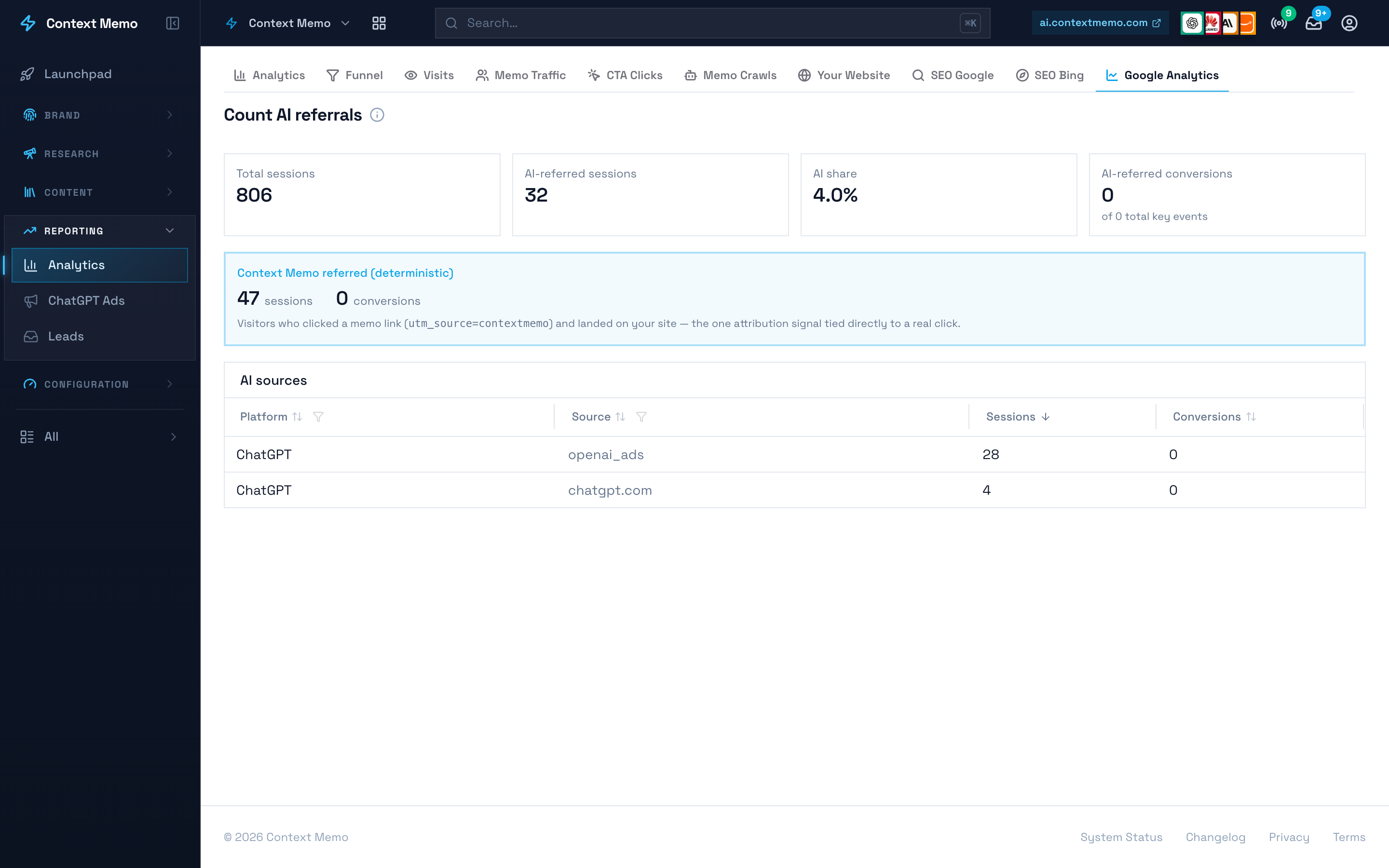
Create a dedicated channel group in GA4 that captures chatgpt.com, chat.openai.com, perplexity.ai, Gemini.google.com, Copilot.microsoft.com, bing.com/chat, and claude.ai. Without that segment, AI traffic hides inside "Referral" or "Direct" and conversion rate by source is unknowable. This is the baseline every later decision gets measured against.
Step 2: Identify Which Pages Are Actually Cited
Entry-page data tells you which specific URLs AI engines send people to, and that set is usually narrower than a team expects. Server logs and bot-crawl data add the other half of the picture: which models fetched which pages, and how often. Optimize those pages first rather than applying a site-wide template change.
Step 3: Rewrite the Top of Each Cited Page for Mid-Funnel Arrival
A visitor who read an AI summary does not need "What is X?" Replace the intro with the thing the model could not render inline: a comparison table, an interactive calculator, proprietary benchmark data, a downloadable checklist, or named case results. Keep the citable answer on the page, since removing it risks the citation, then follow it immediately with the deeper offer.
Step 4: Match the Offer to the Prompt That Earned the Citation
The offer should be a continuation of the query, not a generic contact form. A how-to citation pairs with a template or checklist; a comparison citation pairs with a buying guide or feature table; a pricing citation pairs with a quote calculator; a strategy citation pairs with an audit or short consult. Published 2026 analysis notes that content dense with stats and citations earns 30-40% more AI visibility yet rarely includes a next step, which is exactly the gap this step closes.
Step 5: Stack Verification Proof After Each Substantive Section
AI-referred visitors arrive in verification mode: a model asserted something and they came to confirm it. Named case studies, customer logos, real product screenshots, author credentials, and specific testimonials placed directly after content do that work. Ahrefs data cited in 2026 reporting puts content with clear E-E-A-T signals at 2.8x more AI citations, so the same elements serve both retrieval and conversion.
Step 6: Cut Form Friction and Test CTA Placement Against Data
One or two fields, work email only, one primary CTA, mobile-first layout. A meaningful share of AI search happens inside mobile apps and assistants, so a form that breaks on a phone loses the lead at the final step. Early CTA placement is worth testing on AI-referred pages but should be validated against engagement and conversion data rather than adopted as a universal rule.
Step 7: Instrument the Clickless Majority
With an estimated 93% of AI search sessions ending without a click, and AI Overviews cutting clicks to the top organic result by 58%, referral conversion alone understates the channel. Track branded search volume against citation frequency, check whether AI sources appear in assisted conversion paths, and add a "how did you hear about us" field to forms. Those three signals together approximate the influence that never produces a referrer.
What Should Buyers Consider When Evaluating?
Tooling in this space ranges from pure monitoring to full publish-and-measure systems, and the criteria below separate them faster than a feature list does.
Does it close the loop from citation to conversion, or stop at the report? A dashboard that shows share of voice across models is useful intelligence. Ask what happens after a gap is found: does the tool generate and publish the page, hand over a findings export, or require a separate writing engagement?
Model coverage, stated explicitly. ChatGPT, Perplexity, Gemini, Claude, and Google AI Overviews retrieve and weight sources differently; Perplexity leans on recency and source quality, AI Overviews on domain authority and schema, Claude on training data and document context with limited live retrieval in consumer surfaces. Coverage across several engines beats depth on one.
Where published content lives. Content on the brand's own domain compounds authority the way owned SEO content does. Content parked on a vendor subdomain or walled portal is harder to control after a contract ends and does not accrue the same way.
Attribution integration, not just AI scan data. Confirm the tool connects to GA4, Search Console, and the CRM so AI referral conversion, assisted paths, and lead source can be reconciled in one place. Citation counts with no pipeline link are the exact disconnect that defined 2026 for teams investing in this channel.
Bot and crawl visibility. Knowing which AI crawlers fetched which pages, and when, is how refresh cadence gets scheduled against real retrieval behavior instead of a content calendar. Ask whether crawl-level data is available or only answer-level mentions.
Verification methodology for generated content. Automation that infers positioning instead of verifying it against primary sources introduces the hallucinated claims the program exists to fix. Ask what the structured source of truth is and who reviews it.
Frequently Asked Questions
Why Do AI Search Visitors Convert Better Than Google Organic Traffic?
They self-qualify before arriving. A 2025 analysis of ChatGPT referral traffic measured 15.9% conversion versus 1.76% for Google organic, a 9x difference, and a separate 2026 B2B pipeline analysis put Perplexity sign-up conversion at 11x organic. The buyer read a synthesized comparison, saw the brand alongside alternatives, and clicked anyway, which is a shortlist decision rather than a research click.
How Much Traffic Should a Team Expect From AI Search?
Less than it feels like. 2026 data puts AI referrals at roughly 1.08% of all website traffic, growing about 1% a month, with ChatGPT driving 87.4% of that volume. The volume case is weak; the intent case is strong, which is why conversion rate by source matters more here than session counts.
What Does This Kind of Tooling Typically Cost?
Pricing structures split by what the tool actually does. Monitoring-only tiers are often free or freemium since there is no deliverable; page-building and content tooling tends to be per-seat; platforms that publish, refresh, and attribute generally price on usage or brand volume with custom enterprise quotes. Confirm figures on vendor pricing pages rather than secondhand summaries.
What's the Most Common Mistake Teams Make Here?
Optimizing for citations and never touching the landing page or the attribution model. Citation volume can triple while attributed pipeline stays flat, which is documented in 2026 case reporting. The second most common mistake is sending AI traffic to a homepage or a page that opens with a definition the visitor already read in the AI answer.
Does AI Overview Presence Help if Nobody Clicks?
Yes, but only measurably if branded demand is tracked. Google AI Overviews appear on roughly 16% of queries according to a Semrush study of over 10 million keywords, and they cut clicks to the top organic result by 58%. The influence surfaces as branded search, direct traffic, and assisted conversions, so those three series need to be watched alongside referral volume.
Sources
- Seer Interactive, 2025 analysis of ChatGPT referral conversion (15.9% vs 1.76% Google organic)
- Previsible AI Traffic Report via Search Engine Land, AI-sourced sessions up 527% year over year
- Semrush AI Overviews study, 10M+ keywords, AI Overviews on ~16% of queries
- Conductor, 2026, AI referral share of total traffic and ChatGPT share of AI referrals
- HubSpot 2026 State of Marketing Report, marketer-reported AI referral conversion
- AuthorityTech 2026 B2B pipeline analysis, Perplexity sign-up conversion multiple
- Superlines AI search statistics, clickless session rate and citation/CTA gap
- Ahrefs, E-E-A-T signal correlation with AI citation frequency