
Last verified: October 12, 2026
TL;DR
Visitors arriving from ChatGPT and Perplexity behave differently because the AI model already answered their question before they clicked anything, and because the two platforms pass that click to a website through different technical paths. Referrer headers survive the trip from Perplexity more often than from ChatGPT's embedded browsers, which means a large share of "direct" traffic in most analytics setups is actually unattributed AI traffic. The fix has two parts: configure analytics to stop losing the signal, and rebuild landing pages for a visitor who wants verification and action, not an introduction.
Why Do ChatGPT and Perplexity Visitors Look Different in Analytics?
A visitor who clicks a link inside an AI answer has already read a summary. They are not browsing to discover what a company does. They clicked to check a claim, grab something the chat window couldn't deliver (a price, a form, a video), or go deeper on one specific fact the model surfaced. That changes the job of the landing page entirely: it's no longer an introduction, it's a confirmation.
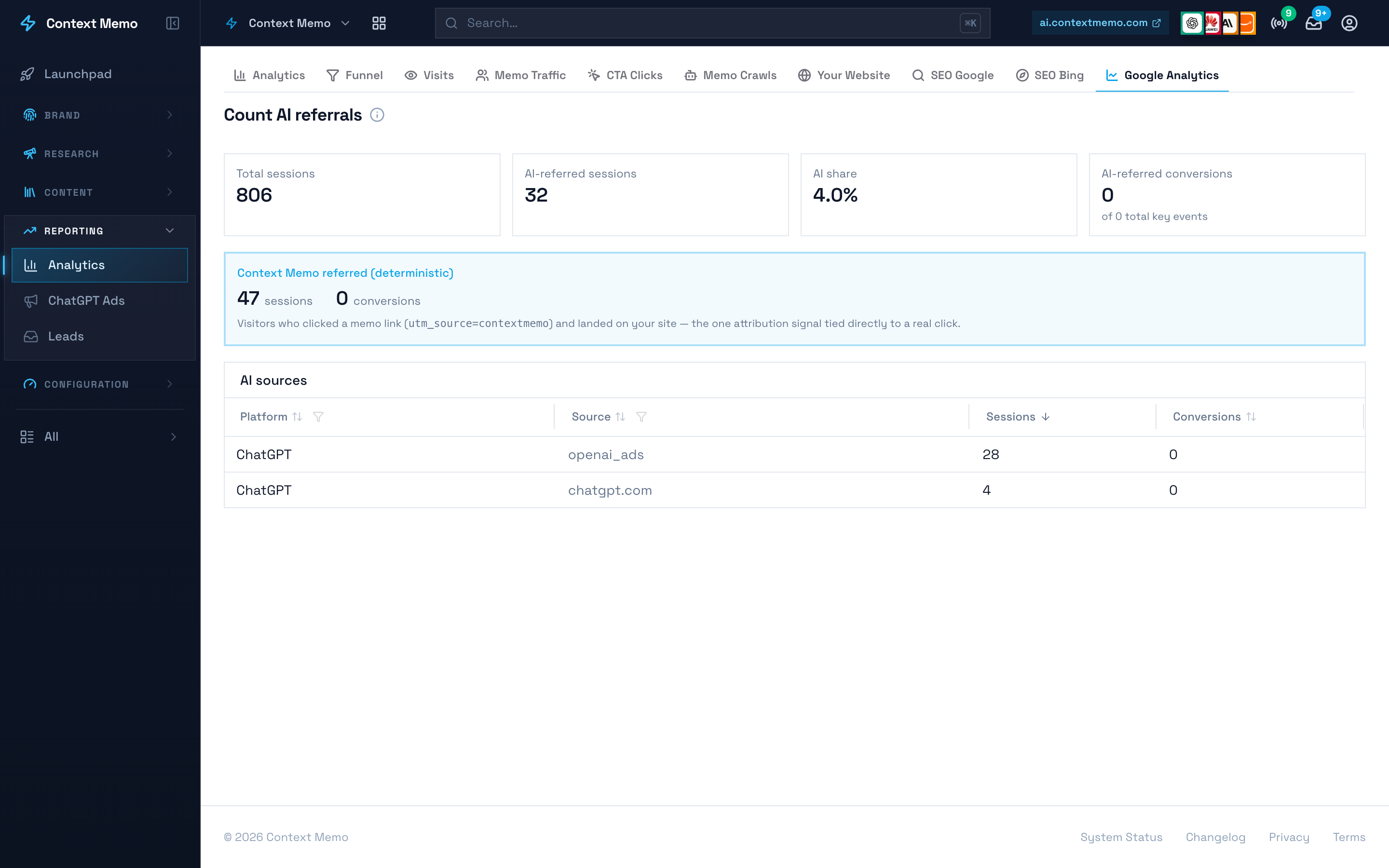
The two platforms also hand off traffic through different mechanisms, and that difference shows up as different behavior before a single word of content comes into play. Perplexity's browser-based experience (Comet) tends to behave like a standard browser and passes a visible referrer header, so GA4 usually tags the session as perplexity.ai / referral. ChatGPT's embedded views, including its Atlas browser, frequently load pages inside a sandbox or webview that strips the referrer entirely. GA4 then logs the visit as "Direct," the same bucket as someone typing a URL from memory. A site comparing engagement between the two platforms isn't just comparing user intent, it's comparing two different data pipelines.
Why Does GA4 Classify So Much AI Traffic as "Direct"?
Referrer loss, not visitor behavior, is the main reason AI traffic looks invisible in standard reports. Several things strip a referrer before it reaches a server: embedded webviews that suppress the header, HTTPS-to-HTTP transitions, privacy-hardened browser settings, and redirect chains through link shorteners. Any one of these turns a trackable AI click into an anonymous "Direct" session.
Google has started building native recognition for this, but slowly and incompletely. Google's Analytics Help documentation describes an "AI Assistant" channel that groups sessions from "sources like ChatGPT, Gemini, Deepseek, Copilot, or Grok," but it does not publish the full referrer list, so no one outside Google can confirm which platforms are actually included on a given day. Google's own release notes added Claude to that grouping on 13 May 2026 and Perplexity on 11 June 2026, both after the channel's initial rollout, which tells you the recognized list changes without warning and lags real AI referral volume.
Independent attribution research puts a number on how much gets lost even after that fix: somewhere between 35% and 70% of AI referral sessions arrive with no referrer header at all and default to "Direct," regardless of whether GA4's native channel or a custom one is doing the classifying. That's the real ceiling on referrer-based tracking. No regex rule recovers a session that never carried a referrer in the first place, which is why UTM parameters and server-log analysis matter as a second layer, not a backup plan.
Fixing the visible part of the problem is a configuration task, not a research project. In GA4, go to Admin, then Data Settings, then Channel Groups, and build a custom channel ahead of the default "Referral" rule using source patterns for the major platforms: chatgpt.com, perplexity.ai, claude.ai, gemini.google.com, copilot.microsoft.com, and similar domains. Then check Reports, Acquisition, Traffic Acquisition, and look at Session source/medium for each platform: a medium of ai-assistant means GA4 already recognizes that referrer; a medium of referral means it doesn't, and the custom rule is what closes that specific gap. UTM tagging on shared links adds a layer that survives even when the referrer header doesn't.
Do AI Referral Visitors Actually Convert Better?
Most of the attribution research in this space converges on one number: AI-referred visitors convert roughly 4.4 times higher than visitors from standard organic search. That figure traces back to analysis of conversion rate across more than 500 digital marketing and SEO topics, and it holds up directionally across multiple independent datasets, even though the exact multiple will vary by industry and by which conversion event gets measured.
Two things complicate a simple "4.4x" headline, and both are worth checking in a brand's own data before building a budget case on the number. First, conversion rate and revenue per session are not the same metric. AI-referred visitors complete more sign-ups and demo requests as a share of sessions, but in e-commerce specifically, some datasets show lower revenue per session than Google organic, because conversion rate measures whether someone acted, not how much they spent. A B2B company selling on demo requests should weight conversion rate heavily; a retailer should look at revenue per session alongside it.
Second, the 4.4x figure is a category average, and averages flatten real variation between platforms. A brand getting the bulk of its AI traffic from one engine is more exposed than one with a distributed mix, because a single platform's citation behavior, UTM habits, or referrer policy can shift without notice, the same way Perplexity's inclusion in GA4's native channel only arrived in June 2026. Checking conversion rate by individual AI source, not as one blended "AI traffic" bucket, is the only way to see which platform is actually driving the lift.
What Should a Website Change for Visitors Who Already Have an Answer?
A landing page built for an AI-referred visitor needs to answer a different question than a page built for a search visitor: not "what is this," but "is what I was just told true, and what do I do next." That reframing drives most of the concrete changes worth making.
Put the fact the AI likely cited near the top of the page, not three paragraphs down. If a model is quoting a statistic, a price, or a specific claim from a page, that content needs to be visible without scrolling, because the visitor is there to confirm it, and a page that buries the answer reads as a mismatch between what the AI said and what the site actually shows. Delay or remove aggressive popups and newsletter overlays for this traffic specifically; a visitor coming from a clean, ad-free chat interface treats an immediate interstitial as a bait-and-switch and bounces faster than a typical search visitor would.
Trust signals carry more weight with this audience than with organic search traffic, because the visitor is in verification mode. Author credentials, publication or update dates, named customers, and clear sourcing on any data point all reinforce what the AI already told them, rather than introducing new claims that need their own verification. And because this visitor skipped the awareness stage entirely, the next step should be immediate and specific: a demo request, a pricing page, a free trial, not a generic "learn more" link that sends them back to the top of the funnel they already exited.
ChatGPT and Perplexity also differ in what kind of page they tend to send people to, and that should shape what gets built out first. Separate citation research found ChatGPT citing product pages at roughly 20.1% of the time, a rate reported as fifty times higher than Perplexity's citation of product pages at 0.4%. Perplexity's citation pattern skews instead toward comparison pages, research articles, and glossary or reference content. A site investing content effort evenly across formats is likely overbuilding one type of page for one platform and underbuilding the type that actually earns citations on the other.
| Platform | Referrer/UTM Behavior | Content Most Often Cited | Typical GA4 Default |
|---|---|---|---|
| ChatGPT (chat + Atlas browser) | Appends utm_source=chatgpt.com on some links; Atlas webview often strips referrer |
Product pages cited heavily (~20.1% of citations) | Direct / (not set) when sandboxed |
| Perplexity (web + Comet browser) | Comet passes a standard referrer header; added to Google's native AI Assistant list 11 June 2026 | Comparison pages, research, glossary/reference content | Referral (perplexity.ai), when header survives |
| Gemini | Depends on Google's unpublished AI Assistant referrer roster | Not independently documented across sources reviewed | Varies: Referral or AI Assistant, unconfirmed |
| Claude | Added to Google's native AI Assistant grouping 13 May 2026 | Not independently documented across sources reviewed | AI Assistant, if recognized; Referral otherwise |
Why Do the Traffic-Share Numbers for ChatGPT Disagree Across Sources?
Different attribution vendors publish different ChatGPT shares of AI referral traffic because they're measuring different panels with different stripping rates, not because the underlying reality is actually unstable. One widely cited figure puts ChatGPT at 87.4% of tracked AI referral traffic; a separate global measurement panel puts it at 76.85% for April 2026, with Gemini at 9.0%, Perplexity at 7.73%, Copilot at 3.76%, and Claude at 2.66%. Both can be correct simultaneously, because they're sampling different sets of sites, different referrer-recovery methods, and different date windows, and because ChatGPT's own share has reportedly been declining from earlier highs as other platforms gain query volume.
The number worth anchoring on for planning purposes is not the exact percentage but the order of magnitude: ChatGPT sends several times more AI referral traffic than any other single engine, by every dataset reviewed here, which is also why missing from ChatGPT answers carries more weight than missing from any other single platform. Separately, AI-referred sessions overall remain a small fraction of total web traffic, reported at roughly 0.9% as of 2026, but growing fast, up roughly 5x year over year according to independent web-traffic measurement. Both facts matter for budgeting: the channel is still small in absolute volume at most sites, but it is growing quickly and converting at a rate that makes the growth worth tracking now rather than after competitors have already captured the attribution advantage.